How Danikor's Automatic Screw Driving System Supports the Future "Lights-Out Factory"?
In today's era of deepening Industry 4.0 implementation, the "Lights-Out Factory", with its core advantages of fully unmanned processes, 24-hour continuous production, and zero manual intervention, has become a core direction for the transformation and upgrading of high-end manufacturing. As the core equipment in the assembly process, the automatic screw driving system is key to whether a lights-out factory can operate stably and ensure a good yield rate. Traditional screw driving equipment can only mechanically execute preset programs. Problems such as screw jamming, wrong screws, and driving misalignment occur frequently, and they heavily rely on manual intervention, fundamentally failing to meet the stringent requirements of a lights-out factory.
I. Source Error Prevention: High-Consistency Screw Feeding, Rejecting Jams and Mixed Screws
The core of a lights-out factory lies in "unattended operation". The feeding stage is the first process in screw driving production and the one most prone to jams, wrong materials, and missing materials. Any minor feeding fault can bring the entire production line to a halt. Traditional equipment requires manual inspection, error correction, and material replenishment, representing a major obstacle to unmanned production.
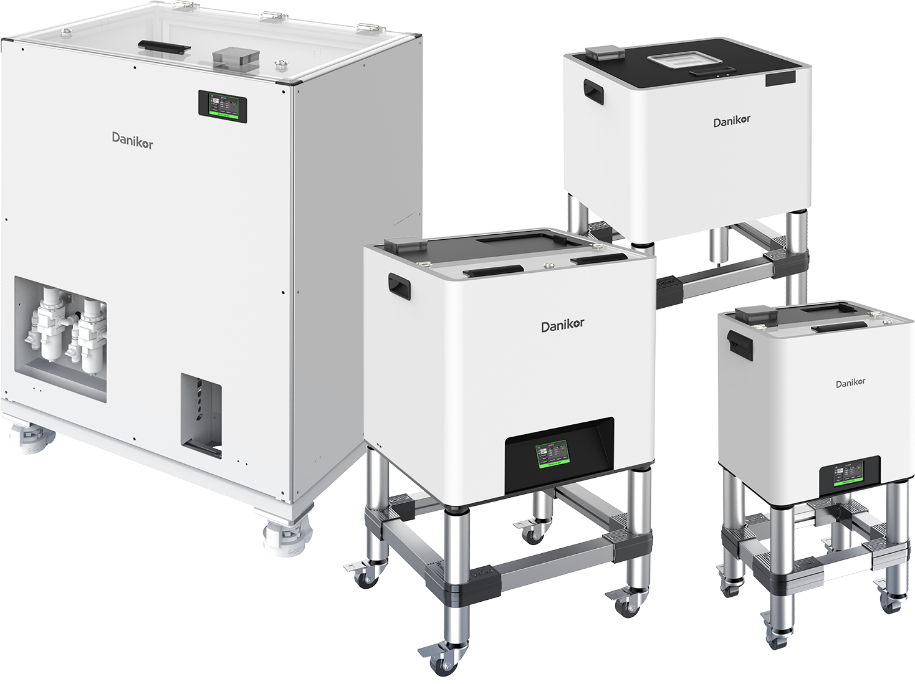
Danikor's stepped screw feeder undergoes systematic optimization from structural design to underlying control logic. Through rail screening technology, adaptive technology, and multi-sensor closed-loop control, the risk of screw jams and abnormal stoppages is significantly reduced. The jam rate is as low as 50 PPM, significantly reducing the frequency of manual intervention and ensuring continuous and stable production line operation.
Additionally, with the optional length detection module, the system can automatically screen out incorrectly specified screws throughout the entire process, achieving automatic identification and rejection of non-conforming screws without manual sorting and inspection, thus solving production quality problems caused by wrong or mixed screws.
II. Core Driving: Blow + Vacuum Pick-Up Driving Module, Negative Pressure Detection Prevents Screw Loss
In diverse industrial assembly sites, the internal spaces of workpieces are often complex and interleaved, with various structural interferences. Traditional screw driving modules are bulky and have limited motion patterns, making it difficult to adapt to fine or high-difficulty spatial driving.
.png "/uploads/image/2026/06/16/1781590996145453/image (9).png")
Danikor's blow + vacuum pick-up driving module possesses strong adaptability to working conditions. It can avoid various interferences based on workpiece structure and operational space, flexibly adapting to screw driving tasks for different products and positions, thus breaking through the working condition limitations of traditional equipment. At the same time, the equipment adopts a vacuum pick-up screw holding mode. Compared to traditional clamping-type driving, it holds the screw more stably, effectively preventing screw misalignment or loss during the driving process. Paired with a negative pressure detection function, it can monitor real-time changes in negative pressure value, accurately identify abnormal situations such as screw drop or pick-up failure, simultaneously complete fault recording and process linkage control, and achieve automatic self-inspection and anomaly sensing during the driving stage. This requires no manual inspection or error correction, perfectly adapting to the precise, unmanned operational requirements under complex working conditions in a lights-out factory.
III. Digital Traceability
Beyond "quick eyes and nimble hands" in hardware, lights-out factories have a far greater demand for data than traditional workshops. Without manual spot checks, the tightening data for every single screw becomes the sole credential for quality traceability.
Danikor's intelligent tightening system not only completes driving with high precision but also features a comprehensive digitized, intelligent software ecosystem:
Multi-strategy tightening control: Supports clamp torque control, rotation angle control, torque error monitoring, cross-threading (slippage) and false-tightening anomaly monitoring, etc., ensuring each screw achieves its optimal tightening state.
Full traceability: Danikor's servo tightening gun has comprehensive data acquisition and storage functions. It can record key parameters for each tightening event in real time, such as slope/torque/angle, and generate a complete torque-angle curve. The tightening data for each event can be uploaded to the factory's MES system, facilitating quality traceability and process optimization. This achieves real-time uploading, querying, traceability, and analysis of tightening data, fully meeting quality control requirements.
Conclusion
Leveraging the core advantages of low jam rate feeding, high-flexibility driving, and full-process data traceability, Danikor's automatic screw driving system has successfully empowered many enterprises to implement lights-out factories, becoming a core support for smart manufacturing in the Industry 4.0 era.
In the future, as lights-out factories continue to become more prevalent, Danikor will continue to delve into technological innovation in automatic feeding and intelligent tightening. With more stable, intelligent, and flexible products, it will help more manufacturing companies achieve unmanned, intelligent transformation and upgrading, injecting new momentum into the development of industrial intelligence.