How Does a Flexible Feeder Achieve High-Takt Loading of Capacitors and Resistors?
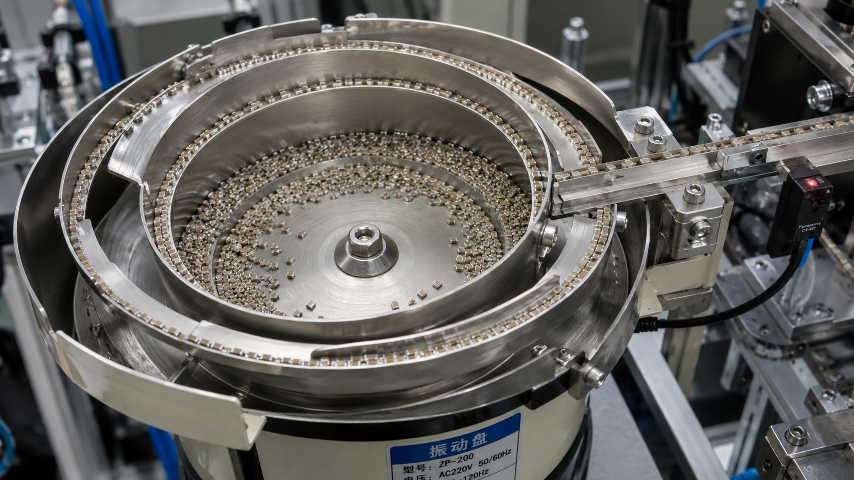
In the fields of modern electronics manufacturing, automotive electronics, and precision semiconductor packaging, the assembly and placement efficiency of passive components such as resistors and capacitors directly determines the capacity utilization of the entire production line. However, traditional vibratory bowl feeding methods often expose pain points such as jamming, reversed parts, scratching, and difficult changeovers when handling extremely small, easily scratchable, irregularly shaped, or high-precision capacitors and resistors. To solve these industry challenges, the flexible tray feeder emerged.
1. Industry Pain Points in Loading Capacitors and Resistors
Extremely small components, easily damaged and deformed: For SMD capacitors and resistors such as 0603, 0402, or even smaller sizes, the surface coating is very thin. Under prolonged friction and impact from traditional vibratory bowls, the edges and corners of the components are prone to chipping, or the electrodes can be damaged.
Difficult to identify polarity and front/back sides: Some capacitors and resistors have directional or front/back characteristics. It is very difficult for traditional mechanical tracks to achieve 100% accurate flipping and rejection of incorrectly oriented parts.
High changeover cost and long cycle time: When a production line needs to switch from producing 0805 size components to 0402 size, traditional vibratory bowls require custom re-tooling or adjustment of mechanical tracks, taking several days and severely impacting production flexibility.
2. Technical Application of Flexible Tray Feeder in Capacitor and Resistor Loading
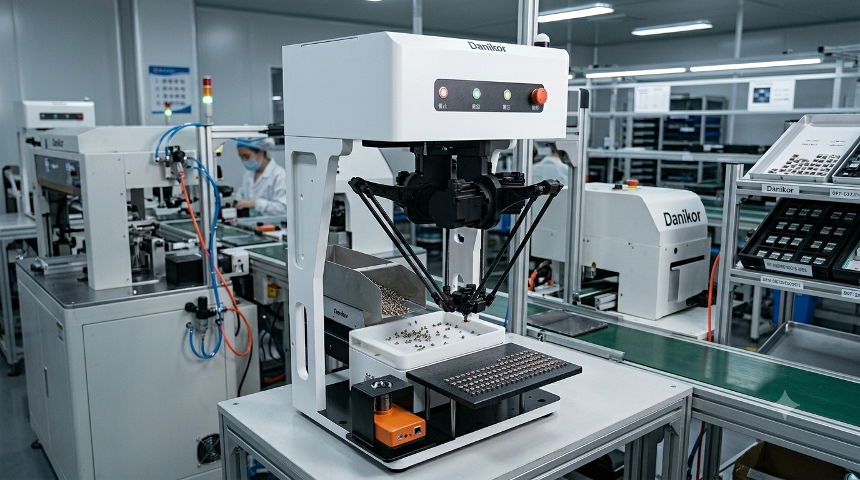
The flexible tray feeder is an intelligent closed-loop loading system composed of a flexible vibratory feeder, a vision system, and a parallel robot. Compared to traditional rigid feeding equipment, the core advantages of the flexible tray feeder lie in its extremely high "flexibility" and level of intelligence.
Intelligent flexible vibration, protecting sensitive capacitors and resistors: During the operation of the flexible tray feeder, capacitors and resistors are dispensed from the hopper onto the surface of the flexible vibratory feeder. The intelligent frequency finding and intelligent amplitude stabilization functions automatically adjust the vibration frequency and amplitude based on the weight of the capacitors and resistors. Driven by gentle voice coil motors, the components achieve regular translational movement, flipping, or convergence towards the center on the tray surface. This non-destructive vibration method ensures zero scratches and zero breakage for high-value, fragile ceramic SMD capacitors throughout the entire loading process.
The path to achieving high-takt loading of 70 pcs/min: In the electronics manufacturing industry, speed is the lifeline. Through extreme optimization of software and hardware, the flexible tray feeder has successfully achieved a high-takt loading efficiency of 70 components per minute. With the support of vision algorithms, the camera completes image capture and data processing during the robot's return stroke. Moreover, the robot adopts a lightweight, high-rigidity carbon fiber linkage design. The extremely low self-weight means that almost all the torque output by the motor is converted into end-of-arm acceleration, perfectly matching the rhythm of high-speed placement machines or testing/packaging lines.
Mechanism analysis of ±0.1mm high-precision tray loading: The tray loading of capacitors and resistors is often a preceding step for subsequent laser welding, dispensing, or packaging processes, demanding extremely high positional accuracy. The flexible tray feeder is equipped with an industrial camera capable of clearly capturing the edge features of resistors, automatically filtering out edge burrs and dust interference. Through secondary "fly" (vision capture during motion), it captures the center offset and angular deviation of the capacitor, transmitting the data in real-time to the control system. The system then performs dynamic angle and position compensation swiftly before the robot places the component.
Against the backdrop of lean manufacturing and flexible production, the flexible tray feeder, with its ultimate protection of components, excellent compatibility, and perfect balance of high efficiency and high precision, has completely broken the bottlenecks of traditional capacitor and resistor loading. Through the perfect collaboration of its three core components (flexible feeder, vision system, and robot), achieving a high takt of 70 pcs/min and high-precision tray placement of ±0.1mm, it has become the standard choice for many leading electronics manufacturers.