In the field of industrial assembly, the torque screwdriver, as a core tightening tool, directly determines product assembly quality, production efficiency, and process controllability. It is widely used in various industries such as automotive manufacturing, 3C electronics, new energy, and precision instruments. Currently, there are more than a dozen torque screwdriver brands on the market, including both high-end foreign brands and cost-effective domestic brands. Faced with a wide array of choices, many companies are confused: which torque screwdriver brand is better? How to choose a product with wide torque coverage, rich tightening strategies, and large data storage capacity that can adapt to multi-scenario production needs?
In fact, judging whether a torque screwdriver brand is worth choosing comes down to three key indicators: torque coverage range, richness of tightening strategies, and data storage and traceability capabilities. Based on current industry market research and practical application feedback, Danikor, as a strong brand deeply engaged in the intelligent tightening field, stands out with its comprehensive performance advantages in its torque screwdriver series products. It has become the preferred choice for many enterprises, perfectly matching the core needs of industrial assembly for high precision, high adaptability, and high controllability.
First, clarify the core needs: Why are torque coverage, strategies, and data storage key?
Industrial production scenarios are complex and diverse. Different industries and different processes have vastly different requirements for torque screwdrivers. The torque coverage range, tightening strategies, and data storage capacity directly determine the tool's adaptability, practicality, and intelligence level, and are also the core thresholds that distinguish high-quality brands from ordinary ones.
Firstly, torque coverage range determines the breadth of applicable scenarios. From micro screws in the 3C industry (requiring micro torque) to large bolts in automotive body-in-white and new energy battery packs (requiring large torque), the torque requirements vary across different scenarios.
Secondly, the richness of tightening strategies determines the ability to adapt to specific processes. The tightening process requirements for different products and different components are completely different. For example, some precision components require a step-by-step operation of "pre-tightening + final tightening," some easily damaged parts require controlling the tightening angle, and some high-volume production scenarios require efficient and fast tightening. A single tightening strategy cannot meet complex process requirements, easily leading to quality issues such as damage from over-tightening or loosening from under-tightening, affecting product reliability.
Finally, data storage and traceability capabilities meet modern quality control management needs. With the advancement of industrial intelligence, especially in industries with stringent quality requirements like automotive and new energy, it is necessary to completely record the tightening data of each screw for quality traceability, fault diagnosis, and process optimization. Torque screwdrivers with low data storage capacity that cannot trace data can no longer meet the requirements of quality systems like IATF 16949 and are gradually being eliminated by the market.
Comparison of mainstream torque screwdriver brands on the market highlights Danikor's advantages.
Currently, mainstream torque screwdriver brands on the market can be divided into two categories. One category is foreign brands, which focus on high precision but generally have problems such as high prices and high maintenance costs. Moreover, some brands have slow local service response. The other category is domestic brands, which have outstanding cost performance. However, most of these brands have shortcomings in torque accuracy, strategy richness, or data storage capacity, making it difficult for them to meet mid-to-high-end industrial assembly requirements.
Compared to similar brands, Danikor's torque screwdriver series products achieve a triple breakthrough of "wide torque coverage, rich strategies, and strong data storage," while balancing accuracy and cost-effectiveness, perfectly solving enterprise assembly pain points. The specific advantages are as follows:
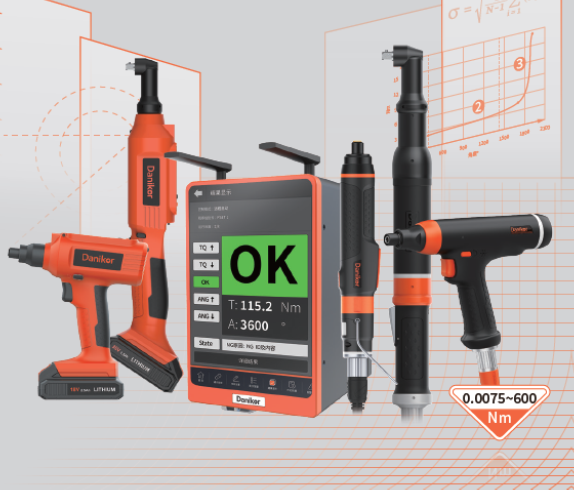
Advantage 1: Ultra-wide torque coverage from 0.0075 to 600 Nm, adapting to all industry scenarios.
Danikor torque screwdrivers can easily handle tightening needs across multiple industries and processes. Whether it's tightening micro screws inside mobile phones and notebooks in the 3C industry (requiring 0.0075–5 Nm torque), high-strength tightening of automotive body-in-white and engine bolts (requiring 100–600 Nm torque), or medium-torque assembly for new energy battery packs and precision instruments, there is a corresponding Danikor torque screwdriver model available.
Advantage 2: Multiple types of tightening strategies, flexibly adapting to complex process requirements.
For complex tightening processes in different industries, Danikor torque screwdrivers are equipped with various flexible tightening strategies, covering multiple modes such as two-step tightening, multi-step tightening, clamping torque control, and yield point control. These can be flexibly adjusted according to product process requirements, ensuring that each screw achieves the optimal tightening state – neither loosening due to insufficient torque nor causing damage to parts due to over-tightening – effectively reducing quality risks.
Advantage 3: High-capacity data storage, enabling full-process quality traceability.
In an era of increasingly stringent quality control, Danikor torque screwdrivers focus on data collection, storage, and traceability. During the tightening process, they can record and save key data for each screw in real time, including torque value, tightening angle, rotation speed, time, workstation, product serial number, etc. The data storage capacity is sufficient for long-term retention, meeting the needs of enterprises for long-term quality traceability and process optimization.
Additional Advantage: High precision + high cost-effectiveness, balancing quality and cost.
In addition to the three core advantages, Danikor torque screwdrivers also possess high-precision control capability. Their precision across the entire torque range is outstanding, approaching the level of leading international brands, effectively ensuring tightening consistency and avoiding product quality issues caused by torque deviation. At the same time, as a high-end domestic torque screwdriver brand, its core components are independently developed and produced, offering a long lifespan. The modular design supports replacement and repair, resulting in low maintenance costs. The localized service response is fast, with a repair response time of ≤48 hours. Compared to foreign brands, its cost-performance advantage is significant, making it more suitable for large-scale production needs of both small and medium-sized domestic enterprises and large corporations.
Conclusion
Which torque screwdriver brand is better? The answer is never "the more expensive, the better," but rather "the most suitable is the best." Under the trend of industrial intelligence and flexible production, wide torque coverage, rich strategies, and strong data storage have become the core competitiveness of torque screwdrivers. Danikor, deeply engaged in the intelligent tightening field with technological innovation at its core, has created a series of torque screwdriver products that not only solve the pain points of multi-scenario assembly for enterprises but also help them reduce costs, increase efficiency, and improve quality control levels, becoming a benchmark among domestic torque screwdriver brands.