In industries such as mechanical assembly, automotive manufacturing, and electronic equipment assembly, screw tightening is a critical process that ensures product structural stability and safety. Developing a scientific and reasonable tightening strategy hinges on the precise control of two major parameters: torque and angle. Their synergistic cooperation directly determines the pass rate of tightening quality. The tightening curve, as an intuitive representation of the changing relationship between these two, serves as a "core tool" for on-site assembly error-proofing and fault diagnosis.
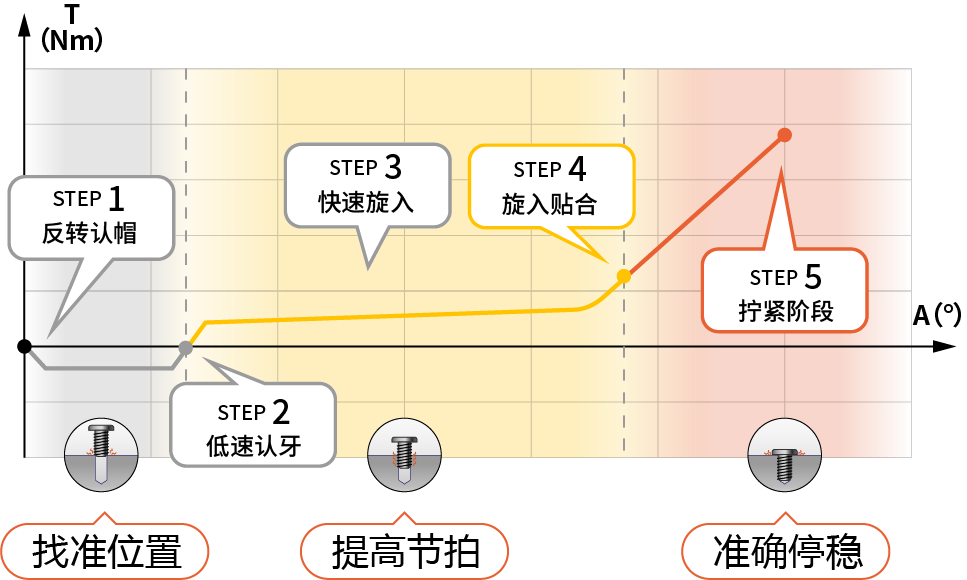
I. The Core Relationship Between Torque and Angle: The Linear Law of Qualified Tightening
The entire process of screw tightening is essentially about applying torque to drive the screw's rotation (angle change), causing the bolt to undergo elastic or plastic deformation, thereby generating preload force to achieve tight contact between components. During a qualified tightening process, the relationship between torque and angle exhibits a clear phased linear law, which can be divided into three key stages. These stages constitute the core components of the tightening curve. Their theoretical basis stems from the combination of Hooke's Law and thread geometry, meaning the bolt's rotation angle is roughly proportional to the sum of the bolt's elongation and the compression of the connected parts.
1. Thread Mating and Seating Phase: Torque is minimal, angle increases slowly.
From the moment the screw is mated (aligned with the threaded hole) until it seats against the surface of the connected part, the core of this phase is to eliminate thread clearance and achieve initial mating. Since no effective preload has been generated, the resistance to screw rotation is very small; therefore, the torque value is near zero and rises gently. The angle increases slowly with the depth of screw engagement. The angle change in this phase is mainly used to overcome the initial clearance between threads, with no effective preload generated. Measurements from some automotive cylinder head bolts show that the preload corresponding to the first 30 degrees of rotation can even be zero, until the nut is fully seated against the flange surface.
2. Elastic Deformation Phase: Torque and angle are directly proportional linearly; torque rises rapidly.
Once the screw seats against the surface of the connected part, tightening enters the elastic deformation zone. At this point, the bolt begins to undergo elastic elongation due to the applied torque, while the connected part is compressed. The ratio of their stiffness determines the distribution of deformation. The key characteristic of this phase is a strict linear proportional relationship between torque and angle, and the torque value rises rapidly. The resistance during the elastic deformation phase primarily comes from the bolt's elastic stress. As the angle increases, the elastic stress accumulates continuously, and the torque increases correspondingly. In practice, the tightening process for most screws reaches the target torque value during this phase, completing a qualified tightening.
3. Plastic Deformation Phase: Torque increment is small, angle increases significantly.
If the tightening force continues to increase, once the torque exceeds the bolt's yield point, tightening enters the plastic deformation zone. Here, the bolt undergoes irreversible plastic elongation, and its stiffness decreases. Therefore, only a small increment in torque is needed to cause a significant elongation of the bolt. On the tightening curve, this is reflected as a gentle rise in torque while the angle increases substantially. Only a few special scenarios (e.g., high-strength bolt connections) require tightening the screw to stop after reaching the yield point to ensure preload stability. In such cases, precise torque-angle combined control is necessary to avoid bolt fracture.
The continuous change through the three stages above constitutes the complete tightening curve. The tightening curve acts like an "electrocardiogram" of the assembly process, recording the dynamic changes in torque and angle in real-time. It not only intuitively reflects whether the tightening process is qualified but also allows for rapid fault location on-site through abnormal curve trends, providing precise data support for assembly error-proofing management. This is the core value of curve overlay analysis functionality in intelligent tightening tools – by comparing multiple tightening curves, one can precisely identify anomalies, optimize processes, and ensure quality stability.
II. Practical Value of the Tightening Curve: Key to Assembly Error-Proofing and Process Optimization
For the mechanical assembly industry, the tightening curve is not only a "sharp tool" for fault diagnosis but also a core basis for optimizing tightening strategies and improving assembly quality. Analyzing the tightening curve yields three core values:
Real-time Error-Proofing: By comparing a standard curve with the actual measured curve, anomalies during tightening can be identified in real-time. Tightening can be stopped promptly to prevent defective products from moving to the next process, reducing rework costs.
Precise Traceability: When an assembly fault occurs, analyzing the curve's characteristics allows for rapid identification of the fault cause (e.g., torque overshoot corresponds to excessive speed or repeated tightening), eliminating the need for step-by-step checks and improving fault handling efficiency.
Process Optimization: Using accumulated curve data over time, torque and angle parameter settings can be optimized. Key parameters like tightening speed and pre-torque can be adjusted to suit screws of different specifications and materials, enhancing the stability of tightening quality.
Conclusion: Torque and angle are the core dual parameters of a tightening strategy. Their relationship during a qualified tightening process exhibits a clear, phased linear pattern, and the tightening curve is the intuitive representation of this relationship. Mastering the characteristics of the curve enables rapid on-site problem diagnosis, process optimization, and reduction of fault-related losses. Danikor's intelligent tightening tools can monitor the output values of torque and angle in real-time during the tightening process, generate and save corresponding curves, accurately detect anomalies like floating height or thread stripping, and provide real-time feedback on tightening results. This reduces later-stage inspection and rework time. Tightening data can be exported or uploaded to MES (Manufacturing Execution System) for easy traceability and analysis. Both operators and process optimization engineers should value the analysis and application of the tightening curve, making the tightening process more precise and efficient, thereby building a solid foundation for product quality.