The internal structure of new energy vehicle controllers is complex. The production and assembly phase requires completing the fastening of numerous components such as PCBA motherboards, connecting wire harnesses, IGBT modules, and aluminum alloy housings. This involves the conveying and precise tightening of a large number of fasteners of various specifications. Various production challenges severely constrain the improvement of production capacity and yield rate.
I. Three Core Pain Points in New Energy Controller Assembly
1. PCBA Fastening Prone to Floating Screws, Creating Quality Risks
Domain controllers contain many precision circuit boards, making them susceptible to the "floating screw" phenomenon. If fasteners are not tightened properly, it can not only result in poor contact of internal components (which may loosen or shift over time with use) but also affect the stability of circuit signal transmission. This can directly trigger electronic control failures in the entire vehicle, posing significant safety risks. Subsequent product rework costs remain high.
2. Wire Harness Tightening Stations Rely on Manual Operation, with Frequent Issues of Wrong or Missed Tightening
Wire harness connection stations in domain controllers often rely on workers using handheld tools for tightening. Long periods of repetitive work can easily lead to operational errors. Issues such as repeated tightening, missed tightening, and inconsistent tightening torque are very common. This not only slows down overall assembly efficiency, failing to meet the demands of mass production, but also makes it difficult to standardize assembly quality, resulting in inconsistent product quality and putting immense pressure on final vehicle quality inspection.
3. Difficulties in Conveying Fasteners with Adhesive, Jams and Material Blockages Disrupting Production Rhythm
The assembly of domain controllers frequently uses special screws coated with oil or adhesive. These screws are sticky and tend to adhere to the inner walls of the track in conventional feeding equipment, creating dirt and debris. This slows down the screw conveying speed and leads to frequent jams and cutting errors. The production line is forced to stop frequently for cleaning and debugging, disrupting the continuous production rhythm and significantly reducing overall workshop production capacity.
II. Danikor's Customized Assembly Solution: A One-Stop Solution to Overcome Domain Controller Assembly Challenges
1. Intelligent Tightening System to Solve the Floating Screw Problem
To address the industry challenge of floating screws in PCBA assembly, Danikor offers a sensor-based intelligent tightening tool. It monitors the entire tightening process in real-time and, combined with a clamping torque control strategy, effectively improves the floating screw defect rate, ensuring strict fastening quality control.
The tool comes with comprehensive anti-error tightening control functions. With a one-key start, it can perform multiple checks, including for floating, cross-threading, and repeated tightening self-diagnostics. This simplifies the process debugging workflow and significantly enhances the stability of precision component assembly.
Core Advantages of the Solution:
High tightening accuracy: Achieves 6σ precision of ±5% across the entire torque range, ensuring precise and controllable fastening force.
Supports multiple advanced control strategies like clamping torque, yield point, and synchronous tightening, suitable for various precision fastening scenarios.
Compatible with major communication protocols including OP bus, TCP/IP, Modbus_TCP, and HTTP. Equipped with expansion digital I/O ports for easy connection to various automated equipment on the shop floor.
2. Fully Closed-Loop Manual Assembly Solution to Standardize Wire Harness Station Workflow
For the manual tightening stations of domain controller wire harnesses, Danikor has developed an integrated assembly guidance and control solution. Paired with a count-type roller feeder and a positioning arm, it creates a fully closed-loop production model encompassing automatic screw feeding, precise positioning, standard tightening, and data retention.
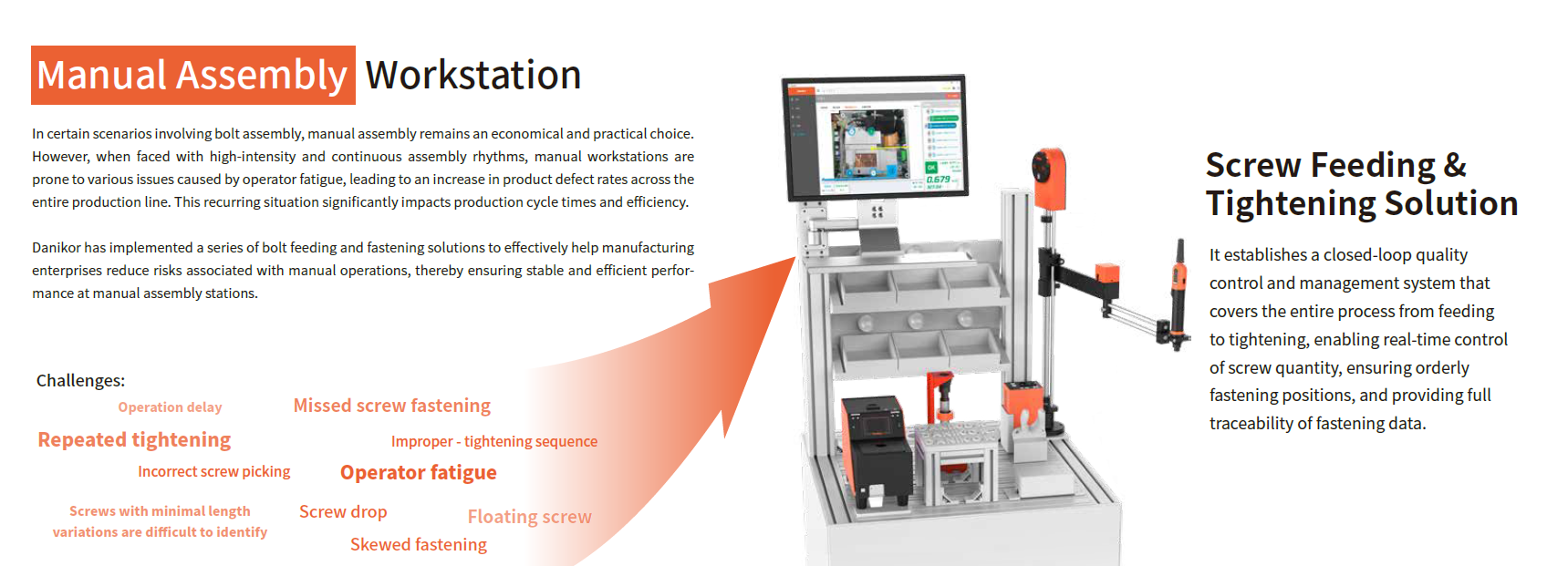
The visual assembly guidance system can interface with multiple external devices to achieve full-process logical closed-loop control, standardizing operator procedures. The positioning arm pre-sets tightening point coordinates, ensuring fastening is completed in the strict required sequence, thus preventing wrong or missed tightening at the procedural level. The counting feeder precisely dispenses screws and monitors screw usage in real-time, eliminating screw shortages or loss.
Core Advantages of the Solution:
Graphical, visual operation interface with clear, intuitive guidance, allowing new operators to get up to speed quickly.
The device automatically switches between tightening stations, providing comprehensive error-proofing and mistake-proofing, significantly reducing human errors.
Automatically collects and stores all tightening data. The complete and traceable data meets the traceability management requirements of complete vehicle manufacturing.
3. Stepped Feeder Adapted for Conveying Adhesive-Coated Screws
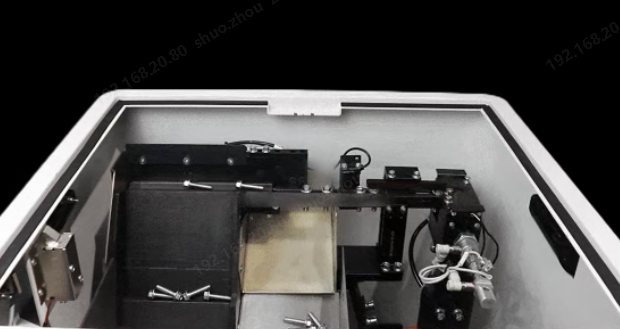
To tackle the challenge of conveying oil-coated or adhesive-coated screws for domain controllers, Danikor offers a stepped feeder equipped with intelligent operational control logic. This effectively resolves issues like sluggish conveying, sticking, and material blockages associated with sticky screws.
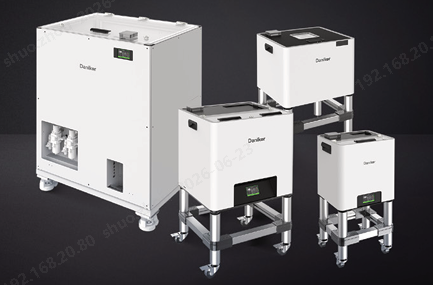
The equipment relies on adaptive conveying technology to ensure orderly screw alignment and stable, consistent conveying speed. Standard position detection components enable closed-loop control of equipment actions, promptly preventing jams caused by cutting errors and ensuring continuous, stable line operation.
Core Advantages of the Solution:
Low jam rate for standard screws, as low as 50 ppm, reducing maintenance stoppages and stabilizing production rhythm.
Enables clean feeding, meeting the clean production standards required for precision assembly in automotive electronics.
Modular functional design allows for flexible addition of functional modules based on actual on-site production conditions, easily adapting to diverse production needs.
Danikor, with its deep expertise in intelligent tightening and automatic screw feeding technologies, comprehensively supports the high-quality mass production of new energy vehicle domain controllers and continues to empower the steady upgrading of the intelligent driving industry.