In the automotive manufacturing field, especially in the core assembly links of OEMs (Original Equipment Manufacturers), bolt tightening quality directly affects vehicle safety and product yield. For the intelligent nutrunner, a key assembly tool, recording tightening data is not a redundant operation, but a necessary measure to ensure quality control, reduce costs, and achieve compliant production. It is also a core requirement of high-end automotive manufacturing.
Tightening data is a "barometer" of assembly quality and the core basis for subsequent quality control, traceability, and optimization. One of the core advantages of the intelligent nutrunner is its ability to collect and upload tightening data in real time, solving the pain points of traditional tightening: "no records, difficult traceability, and error-prone."
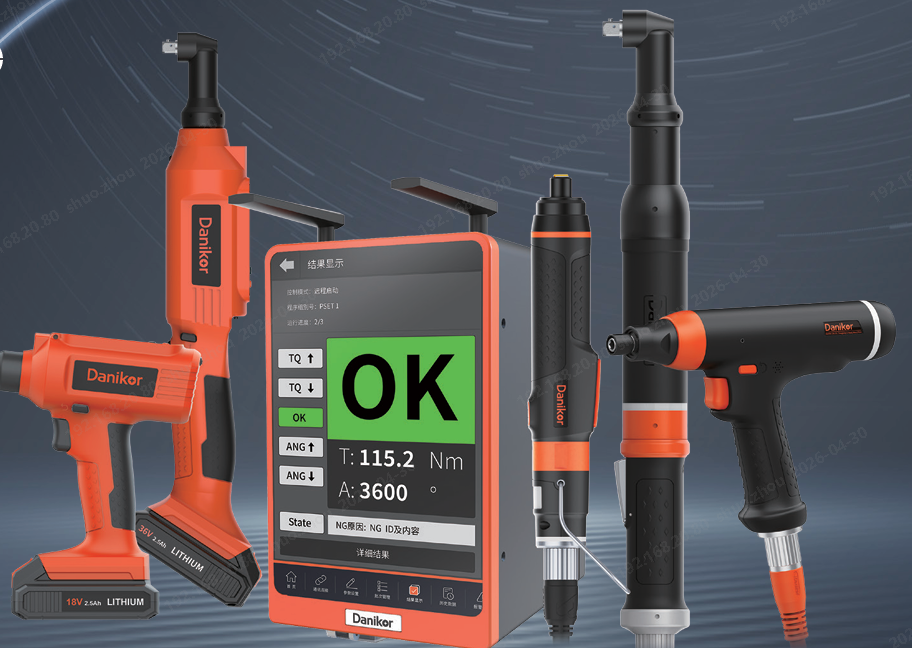
I. Recording Tightening Data Primarily Solves 3 Major Industry Pain Points
For automotive OEMs, especially on critical stations like powertrains, chassis suspensions, or new energy vehicle battery packs, the consistency and reliability of bolt tightening are paramount. Recording tightening data is essential for mitigating risks, improving efficiency, and meeting compliance requirements.
1. Achieve Quality Traceability, Quickly Locate Problems
Traditional tightening relies on manual labor or ordinary tools with no data recording. Once a product failure occurs due to loose bolts or over-tightening, it is impossible to locate the specific problem station, workpiece, or operator. This forces a full-batch rework or recall, which not only increases production costs but also harms brand reputation.
The intelligent nutrunner can record key data in real-time, such as torque, angle, speed, tightening time, and station number, and synchronously upload it to the MES (Manufacturing Execution System), forming a complete data traceability chain. Once a quality anomaly occurs, it allows for rapid traceability to the specific tightening point to determine whether the cause is tool deviation, process fluctuation, or operational error. This enables precise problem-solving, avoids large-scale rework, and reduces losses.
2. Ensure Assembly Consistency, Build a Safety Fortress
For bolts in critical automotive areas, insufficient tightening torque can lead to loosening and detachment, while excessive torque can cause bolt breakage. Both can create serious safety hazards. By recording tightening data, the intelligent nutrunner monitors the tightening process in real-time. If abnormalities such as missing tightening, insufficient tightening, or over-tightening occur, it immediately issues an automatic warning, preventing defective products from moving to the next process.
3. Meet Industry Requirements, Aid Process Optimization
The automotive manufacturing industry explicitly requires that operational data for key processes be retained for future reference. As core process data, tightening data is an important credential for compliance audits.
Furthermore, vast amounts of tightening data support process optimization for OEMs. By statistically analyzing tightening data from different stations and under different working conditions, they can accurately identify process bottlenecks, tool wear patterns, and tightening programs. This helps improve assembly efficiency and product yield, achieving cost reduction and efficiency increase.
II. Danikor Intelligent Nutrunner: Deeply Rooted in Automotive OEMs, Precisely Adapting to Industry Needs
With over a decade of experience in the automotive automation assembly field, Danikor focuses on serving automotive OEMs and their upstream and downstream supporting enterprises. Concentrating on the tightening needs of core stations such as powertrains, chassis, and battery packs, Danikor has developed an intelligent nutrunner that not only achieves high-precision tightening but also efficiently handles data recording and traceability, perfectly adapting to the stringent requirements of automotive manufacturing.
1. High-Precision Data Acquisition, Ensuring Data Authenticity and Validity
The Danikor intelligent nutrunner is equipped with high-precision sensors and supports data upload, ensuring that every set of tightening data is authentic and accurate, providing a reliable basis for quality traceability and process optimization.
2. Full-Link Data Traceability, Adapting to OEM Digital Management
The device supports real-time uploading and disconnected data transmission for tightening data. It can seamlessly connect to the OEM's MES system, achieving full-process traceability, queryability, and archiving of data. It also helps automakers build a digital quality control system, enabling transparent management of the assembly process.
3. Deep Adaptation to Automotive Scenarios, Covering All Working Conditions
The Danikor intelligent nutrunner features an ultra-wide torque range of 0.02 to 600 Nm, suitable for all scenarios from small precision screws to high-torque body bolts. Whether for conventional fuel vehicle engine assembly or new energy vehicle battery pack assembly, it performs stably. Currently, the product is widely used by leading automakers such as BYD, Geely, and Volkswagen, earning high industry recognition.
Conclusion
For automotive OEMs, recording tightening data is not an extra burden but a crucial measure to improve quality control, reduce production costs, and ensure product safety. As the core carrier of data acquisition, the performance of the intelligent nutrunner directly affects data accuracy and traceability effectiveness.
Danikor focuses on meeting the needs of OEMs, creating an intelligent nutrunner that is high-precision, traceable, and adaptable to multiple scenarios. With professional technology, Danikor helps automakers achieve digital and standardized control of the tightening process, fortify product quality lines, and promote high-quality development in the automotive assembly industry.