In high-end industrial scenarios such as automotive manufacturing, 3C electronics, medical devices, and precision component assembly, the precision and stability of screw tightening directly determine product quality and service life. When many companies purchase torque screwdrivers, a common misconception exists: they judge the tool's tightening accuracy and production-line reliability based solely on its stated static precision.
However, on actual production lines, most high-precision screwdrivers, after enduring 10,000, 100,000, or even 1 million high-frequency operations, will successively experience problems such as accuracy degradation, torque drift, increased dispersion, and higher reject rates. This shows that a single precision parameter is completely insufficient to define the real performance of a tightening tool. To determine whether a screwdriver is accurate, stable, and reliable over the long term, it is necessary to combine an evaluation of the tool's hardware capability indices (CM/CMK) with the production process capability indices (CP/CPK).
I. Core Misconception: Single-Point High Precision ≠ Long-Term Production Accuracy
The "high precision" stated by manufacturers is a single-point static precision measured under ideal, constant-temperature, no-load calibration conditions. It only represents the instantaneous performance of the tool when brand new. However, mass production involves high-frequency cyclic operations, full-range switching, long-term fatigue wear, and variable interference from the interplay of Man, Machine, Material, Method, and Environment.
Ordinary high-precision screwdrivers often are "accurate when new, but perform worse over time." After prolonged operation, they are prone to torque drift and excessive dispersion, leading to problems like false seating (floating screws), thread stripping, over-tightening, and loose tightening. True tightening accuracy is a comprehensive reflection of hardware performance, long-term stability, and adaptability to complex conditions. It needs to be fully verified through the four indices: CM, CMK, CP, and CPK.
II. Core Knowledge: The Difference and Standards between CM/CMK and CP/CPK
The calculation logic for CM/CMK and CP/CPK is the same. The core difference lies in the test conditions: CM/CMK assess the inherent capability of the equipment itself, while CP/CPK assess the capability of the actual mass production process. Together, they form the gold standard for accepting industrial tightening equipment.
1. CM/CMK: Equipment Hardware Capability under Ideal Conditions
CM/CMK are tested under controlled, ideal conditions without external interference. They only evaluate the precision and stability of the tightening tool itself. They are key indicators for new equipment acceptance, post-overhaul checks, new product trials, and defect tracing. The test requires at least 50 consecutive sample data points.
CM (Machine Capability - Precision Reserve): Measures the concentration of the tool's accuracy. Determines if the equipment's precision meets the process torque requirements. A higher value indicates a better hardware precision reserve and better dispersion control.
CMK (Machine Capability Index - Torque Targeting Ability): Measures the deviation of the average torque output from the target center value. Determines whether the torque can accurately hit the process target. As in archery: CM determines if the arrows are clustered together, while CMK determines if the cluster is centered on the bullseye. A higher value indicates more concentrated tightening precision and more stable quality.
According to the ISO 5393 industrial tightening standard, equipment capability is clearly graded:
CM, CMK ≥ 1.67: Equipment capability is sufficient, suitable for high-end precision workstations.
1.33 ≤ CM, CMK < 1.67: Equipment capability is acceptable, suitable only for ordinary workstations.
CM, CMK < 1.33: Equipment capability is insufficient, requiring repair or replacement.
2. CP/CPK: Production Process Capability on the Actual Line
If CM/CMK are the tool's "hardware qualifications," CP/CPK are the line's "actual performance results." CP/CPK are tested under real production conditions, integrating the five major interference factors of Man, Machine, Material, Method, and Environment, reflecting the stability and consistency of batch production.
The test requires collecting 100 valid samples per subgroup for 25 subgroups under stable process conditions, calculating process capability through the mean and standard deviation. High-end critical workstations uniformly require CP/CPK ≥ 1.67.
CP (Process Capability - Precision Reserve): Reflects the overall dispersion control level of torque in mass production. Represents the process precision reserve.
CPK (Process Capability Index - Torque Centering): Reflects the deviation of the mass production torque from the target. Directly determines the batch pass rate and production stability.
Higher CP/CPK values indicate stronger anti-interference ability of the equipment, better consistency in batch tightening, and lower mass production reject rates.
III. The Relationship Between the Four Indices
Analyzing CM/CMK together with CP/CPK can accurately distinguish between equipment hardware problems and application/condition problems. This is the core basis for regular equipment calibration and process optimization.
CM/CP are too low → Insufficient hardware capability. If the precision reserve index does not meet the standard (regardless of the deviation index), it indicates an inherent hardware defect of the equipment (high dispersion, poor precision foundation). This cannot be fixed by calibration and requires replacing the equipment with higher-performance models. Furthermore, the higher the CM/CP, the higher the equipment's safety margin and the lower the quality risk.
CMK/CPK are too low → Torque deviation has occurred. If CM/CP meet the standard but CMK/CPK do not, it means the equipment's hardware precision is acceptable, but the torque center has drifted after prolonged use. This is a后天 (post-acquisition/operational) condition problem. It can be fixed through regular calibration and fine-tuning of parameters. This is the core reason why tightening tools must be calibrated periodically.
In short: CM/CP ensure the precision floor, while CMK/CPK ensure the production accuracy. Only when both pairs are excellent is the tool a qualified precision tightening tool.
IV. Danikor Torque Screwdriver: Dual High Standards for Hardware + Process Capability
Targeting the common industry pain point where tools "look good on single-point precision but are unstable across the range and drift over time," Danikor's intelligent torque screwdriver strictly adheres to the ISO 5393 standard. It achieves upgrades across hardware, algorithms, stability, and condition adaptability, meeting CM/CMK and CP/CPK standards across all dimensions. It is suitable for high-precision assembly scenarios in automotive, medical, 3C electronics, and other industries.
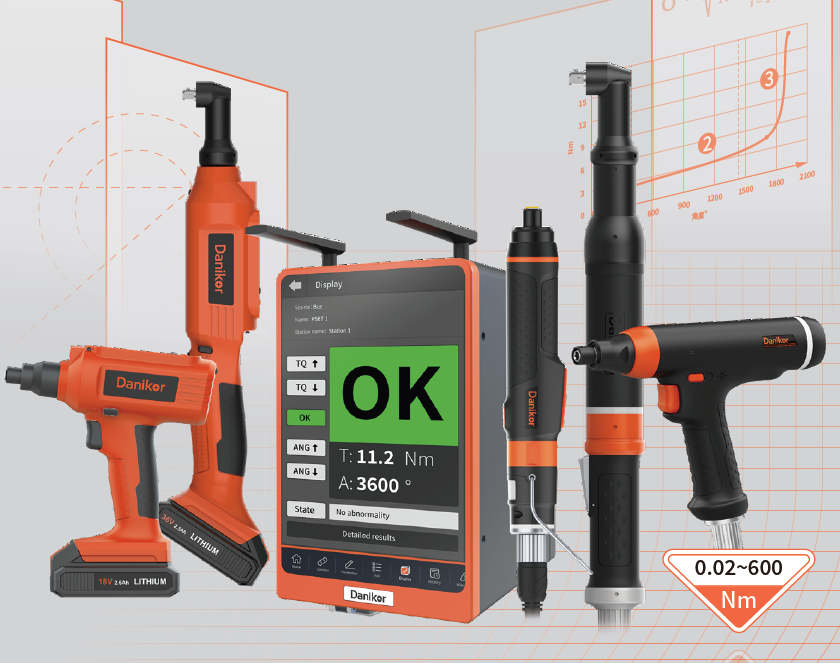
Danikor's torque screwdriver stably achieves CMK > 1.67 across full-range, multiple torque points. It has ample precision reserve, highly concentrated torque output, and no range blind spots. It easily passes high-end equipment factory acceptance and post-overhaul inspections.
Equipped with a high-performance brushless motor + closed-loop torque feedback system. Core components are wear-resistant and decay-resistant. After millions of fatigue test cycles, there is no torque drift or accuracy degradation, solving the problem of ordinary tools "becoming less accurate over time" and reducing maintenance and calibration costs.
Consistently maintains CP/CPK ≥ 1.67 under actual production line conditions. Effectively counteracts fluctuations in personnel, materials, and environment. Batch tightening shows low dispersion and no drift, ensuring good batch-to-batch consistency, adaptable to various critical and demanding workstations.
Supports dual monitoring of torque + angle and intelligent abnormality recognition, preventing defects like false seating, thread stripping, and over-tightening. Full process data is retained and traceable, making it easy for enterprises to perform index verification, quality traceability, and refined production control.
V. Conclusion: Accurate Tightening Relies on Fully Dimensional Stability
In summary, high precision absolutely does not equal accurate tightening. Single-point static precision is only a basic parameter and cannot measure the long-term mass production performance of a tool. A truly high-quality tightening tool must possess both excellent CM/CMK hardware capability and excellent CP/CPK mass production process capability.
Danikor's intelligent torque screwdriver moves beyond parameter hype. With high-standard equipment capability and mass production stability, it solves the precision assembly pain points of torque drift, accuracy degradation, and batch instability. It helps enterprises achieve long-term zero-defect mass production, reduce costs, increase efficiency, and stabilize product quality.