Current Controlled vs Transducerized Electric Screwdrivers How to Choose
Short answer: Choose a current-controlled electric screwdriver when the joint is stable, the process risk is moderate, and cost-effective torque control is the priority. Choose a transducerized screwdriver when torque must be measured directly, torque-and-angle results must be verified, tightening curves must be analyzed, or every fastening result must be traceable. The right choice depends on joint behavior, defect risk, data requirements and the cost of a missed tightening error.
Both tool types can support controlled industrial screwdriving, but they do not obtain torque information in the same way. That difference affects how reliably the system can identify abnormal fastening behavior, how much process data is available, and which applications the tool is best suited to.
What Is a Current Controlled Electric Screwdriver
A current-controlled electric screwdriver regulates the motor and estimates tightening load from electrical and operating signals. Because motor current rises as resistance increases, the controller can use a calibrated relationship between current and torque to stop the tool at the programmed threshold.
This approach is practical for repetitive assembly where screw type, material, joint condition and fastening sequence remain consistent. It can provide programmable speed, multi-stage tightening, OK or NG judgment and production-system communication, depending on the controller and model. However, the tool does not rely on a torque transducer at the output to measure torque directly. Changes in friction, bit condition, thread condition, temperature or joint stiffness can therefore affect how closely the estimated value represents the actual torque at the joint.
What Is a Transducerized Electric Screwdriver
A transducerized electric screwdriver contains a torque sensor in the drivetrain. The tool measures torque during the fastening cycle and combines that signal with rotation-angle and speed data. The controller can then evaluate the complete tightening process rather than only determining when the motor load reaches a set threshold.
This architecture supports torque-and-angle monitoring, tightening-curve analysis, multi-stage strategies, abnormal-process detection and detailed result records. It is typically selected for safety-critical or quality-critical joints, mixed-product lines, assemblies with costly rework, and processes that require audit-ready traceability or MES integration.
Key Differences at a Glance
Selection factor | Current controlled | Transducerized |
Torque information | Derived from motor current and calibrated operating behavior | Measured by an integrated torque transducer |
Angle monitoring | May be available, depending on tool and controller | Commonly combined with measured torque for process verification |
Tightening curve | Usually more limited for joint diagnosis | Torque angle and speed data can support curve analysis |
Joint variation | Best when materials friction and joint behavior are stable | Better suited to variable or quality-critical joints |
Error detection | Suitable for basic threshold and sequence checks | Stronger for identifying cross-threading stripped threads missing parts and abnormal seating |
Traceability | Can record results depending on the system configuration | Designed for detailed fastening records and process evidence |
Cost | Generally lower initial investment | Higher initial investment with deeper control and verification |
Typical use | Stable repetitive assembly and moderate-risk joints | Automotive EV battery energy storage electronics and other controlled assembly |
Why Torque Measurement Method Matters
The torque applied by a screwdriver is not the final purpose of fastening. The purpose is to generate sufficient and repeatable clamp load. Friction at the thread and under the screw head consumes a large share of the input torque, so two fasteners that reach the same torque can still produce different clamp loads.
A current-controlled tool can perform well when the process is stable and validated. A transducerized tool adds direct torque measurement and angle information, which gives engineers more evidence about how the joint behaved. For example, an unusual angle before reaching the torque threshold may indicate cross-threading, a missing washer, damaged threads or unexpected joint compression. Torque alone may show that the target was reached; torque plus angle can help show whether it was reached in the expected way.
When a Current Controlled Screwdriver Is the Better Choice
A current-controlled screwdriver is often the more economical choice when the assembly process has low variation and the consequences of a fastening defect are limited. It may be suitable when:
· The same screw, material and joint design are used repeatedly.
· The process has been validated and friction conditions are controlled.
· Basic torque control, speed control and OK or NG judgment are sufficient.
· The application does not require direct torque measurement for quality records.
· The line needs a balance between production control and equipment cost.
Typical examples include stable electronics, appliance or general industrial assembly stations where the joint is non-safety-critical and periodic process checks can confirm continued capability.
When a Transducerized Screwdriver Is the Better Choice
A transducerized screwdriver is usually preferred when verification is as important as control. Select it when:
· The joint is safety-critical or quality-critical.
· Torque and angle must both stay within defined windows.
· Tightening curves are needed for diagnosis, validation or continuous improvement.
· The system must detect abnormal seating, cross-threading, stripped threads, floating screws or missing components.
· Every cycle must be linked to a product, operator, station or serial number.
· The line requires PLC or MES integration and auditable fastening records.
· Product variants or frequent changeovers require multiple controlled programs.
These needs are common in automotive OEM and component assembly, EV battery and powertrain production, energy storage systems, robotics, electrical equipment and high-value electronics.
Five Questions to Ask Before Selecting a Tool
1. How critical is the joint? Define the effect of loose, over-tightened or incorrectly seated fasteners on safety, function, warranty and rework.
2. How stable is the fastening process? Review screw coatings, materials, joint stiffness, tolerances, lubrication and supplier variation.
3. Which defects must be detected? A torque threshold may be sufficient for one application, while another needs torque-angle windows and curve-based diagnosis.
4. What data must be retained? Specify the required result fields, storage period, serial-number linkage and PLC or MES interface before choosing hardware.
5. How will the process be validated? Test the proposed tool on real hard and soft joints, including normal parts and representative failure modes, rather than selecting by torque range alone.
Do Not Select by Torque Range Alone
Two tools may cover the same nominal torque range but provide very different levels of process control. A sound selection also considers tool speed, joint type, duty cycle, ergonomics, reaction force, bit and socket interface, controller capacity, communication protocol, program management and calibration requirements.
The most useful trial reproduces the actual fastening process. Evaluate normal joints and controlled defects, then compare repeatability, cycle time, curve consistency, operator handling and the system's ability to separate good and bad fastening events. This converts tool selection from a catalogue comparison into a verified process decision.
How Danikor Supports Both Assembly Strategies
Danikor provides current-controlled and transducerized intelligent electric screwdrivers for handheld and fixed assembly. Depending on the selected system, available functions include programmable multi-stage tightening, torque and angle monitoring, OK or NG judgment, tightening-curve analysis, program management, fastening-result storage and PLC or MES connectivity.
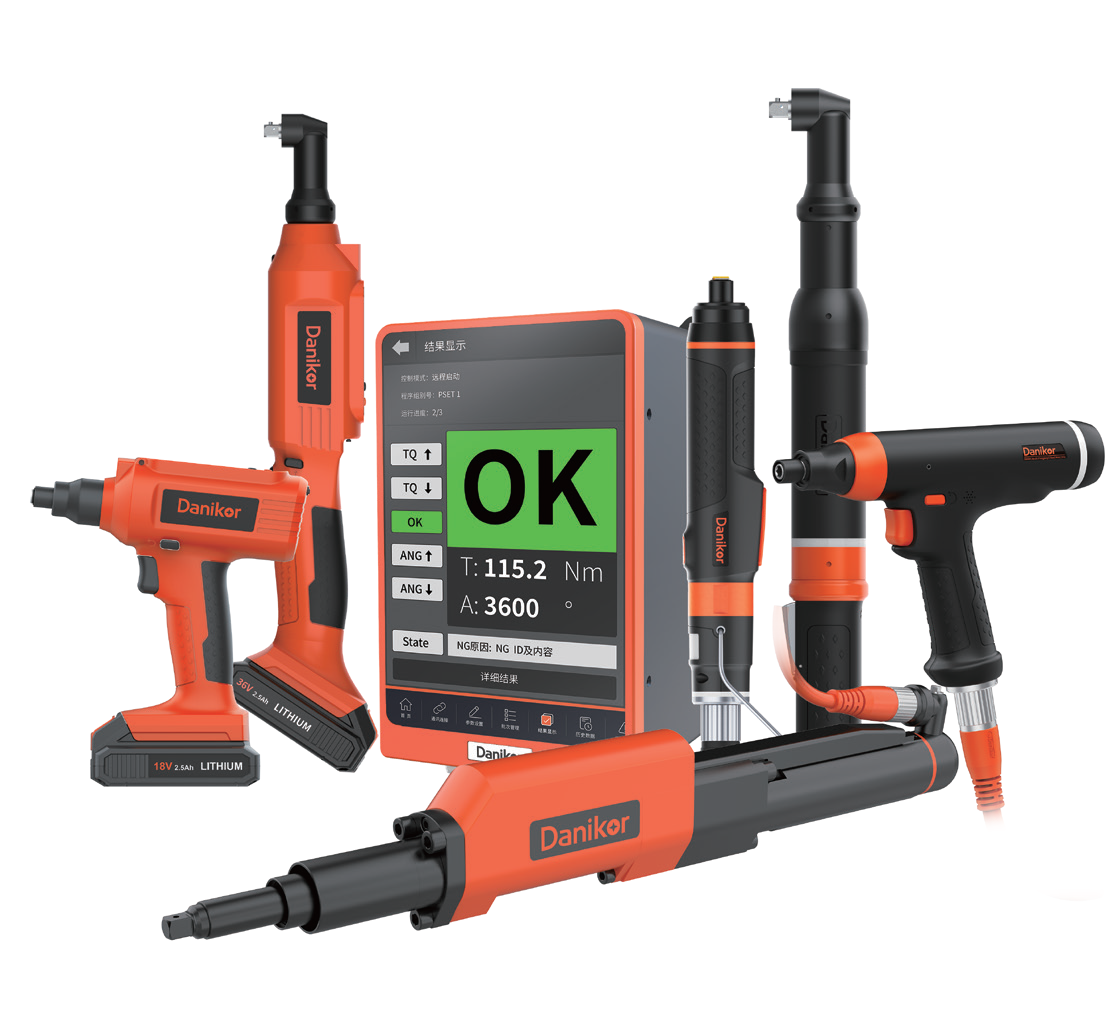
For stable, moderate-risk applications, a current-controlled model can provide efficient process control without unnecessary system complexity. For quality-critical applications, Danikor transducerized tools provide direct torque measurement and deeper process verification. The final recommendation should be based on the joint, production environment, traceability requirement and validated failure modes.
Conclusion
A current-controlled electric screwdriver controls fastening through the relationship between motor current and load. A transducerized screwdriver measures torque directly and combines it with angle and process data. Current control is often sufficient for stable, cost-sensitive applications; transducerized control is the stronger choice when the assembly requires verification, defect detection and traceability.
Before selecting a tool, define the joint risk, the defects that must be detected and the data the production system must retain. Danikor can evaluate your screw specification, target torque, joint material, cycle time, workstation design and communication requirements to recommend a suitable tightening configuration.
Frequently Asked Questions
Is a transducerized screwdriver more accurate than a current-controlled screwdriver?
A transducerized tool measures torque directly, so it generally provides stronger torque verification and process evidence. A current-controlled tool can still deliver repeatable results in a stable, validated joint. Accuracy should be confirmed under the real hard or soft joint conditions, not inferred from the control method alone.
Can a current-controlled screwdriver detect cross-threading?
It may identify some abnormal cycles through time, angle, current or threshold limits, depending on the controller. A transducerized system with torque-angle windows and curve analysis normally provides more diagnostic information for distinguishing cross-threading from a normal fastening cycle.
What is torque-and-angle monitoring?
Torque-and-angle monitoring checks both the applied torque and the fastener rotation. It helps verify not only that the target torque was reached, but also that the joint developed within an expected angular range.
Which screwdriver is better for MES traceability?
Both types may communicate results, but a transducerized system is typically chosen when detailed torque, angle, curve, program and result data must be associated with a product or serial number. Confirm the required protocol, fields and storage capacity during selection.
Which tool is suitable for automotive or EV battery assembly?
Quality-critical automotive and EV battery joints commonly favor transducerized tools because they require direct torque measurement, torque-angle verification, error proofing and traceable fastening records. Non-critical subassemblies with stable joints may still use validated current-controlled tools.
How should an electric screwdriver be validated before purchase?
Run trials on production-representative joints, including expected variation and known defect samples. Compare repeatability, tightening curves, cycle time, defect separation, operator handling and data integration before approving the tool.