Why Automotive Torque Data Traceability Is Essential for Assembly Safety
A fastening process is not fully controlled merely because a repair order shows “complete.” Automotive manufacturers must be able to verify that each required joint was actually tightened, that the measured result met the approved process limits, and that the evidence remains available for later investigation.
Ford recall 26V550, involving 23 vehicles, provides a useful example. According to the Part 573 report submitted to the U.S. National Highway Traffic Safety Administration, a software coding error was introduced during an update to torque repair carts used for offline repairs at assembly plants. The issue could allow a repair task to close without requiring the operator to perform the prescribed torque operation. The affected population included certain 2026 Ford Maverick, F-150 and Bronco Sport vehicles.
The event was small in volume, but its process lesson is broad: automotive fastening quality depends on verifiable execution, effective interlocks and complete tightening records across both the main assembly line and offline repair stations.
Quick Answer
Automotive torque data traceability is the ability to connect each critical fastening result to the relevant vehicle or component, joint, program, tool, time and acceptance status. A traceable tightening process proves that the operation occurred and helps manufacturers identify affected units quickly when a deviation is discovered.
What Happened in the Ford 23 Vehicle Recall
The official recall report identifies the issue as an offline repair control problem rather than a general defect affecting the entire production population. Vehicles requiring certain adjustments were routed through torque repair carts at assembly plants. A defective software version introduced a logic error into this repair process.
Because of the coding error, the repair cart could close a task without requiring the operator to complete the specified torque operation. Ford reviewed repair history and confirmed improper torque values for 23 vehicles, which became the potentially affected recall population.
This distinction matters. The risk did not arise simply because a tightening tool failed to reach torque. It arose because the digital workflow could indicate completion without reliable confirmation that the required fastening process had been executed correctly.
Why a Missing Torque Verification Step Creates Vehicle Risk
Bolted joints connect structures and systems throughout a vehicle, including body assemblies, chassis components, electrical equipment and other functional parts. Each joint has application-specific requirements. If a required tightening operation is omitted or the achieved torque falls outside the approved process window, the connection may not perform as intended.
The precise consequence depends on the joint. Potential outcomes can include loosening, component movement, noise, electrical malfunction, reduced structural performance or other safety-related conditions. For this reason, an automotive quality system must verify more than a work-order status. It must preserve objective fastening evidence.
The recall also shows why traceability matters after production. When reliable records connect process results to individual vehicles, a manufacturer can narrow the affected population, investigate the relevant time window and take corrective action without assuming that every vehicle built at the plant is affected.
Three Weaknesses in Traditional Offline Repair Torque Control
Offline repair stations are part of the production quality system, but they may operate differently from the main line. When repair processes depend on loosely controlled software and conventional manual tools, three weaknesses become especially important.
1 Completion Status Without Process Verification
A repair system may record a task as complete without checking whether the tightening cycle actually occurred or whether it returned an accepted result. If workflow logic fails, the digital record can become disconnected from the physical operation.
2 Limited Control of Torque Angle and Speed
Conventional tools may provide limited control over torque, angle or speed. This makes it more difficult to standardize rundown, seating and final tightening across different joints and repair conditions. The result can be insufficient tightening, overtightening or other abnormal fastening behavior.
3 Incomplete Fastening Records
A basic repair record may show only that a task was opened and closed. Without measured torque, angle, cycle time, program, tool identification and OK/NG status, quality teams have less evidence for root-cause analysis and affected-unit identification.
How Danikor Intelligent Tightening Supports Automotive Quality Control
Danikor intelligent tightening solutions are designed for automotive assembly, component production, offline rework and other quality-critical fastening applications. The system combines controlled tightening, process mistake-proofing and fastening data traceability to reduce the gap between a completed work order and a verified physical result.

Danikor intelligent tightening tools and controller support controlled fastening and real-time result verification.
High Precision Torque Control for Different Automotive Joints
Automotive body, chassis, powertrain and electrical assemblies can require different torque, speed and angle strategies. Danikor intelligent tightening tools use an integrated torque sensor and programmable multi-step tightening to control the fastening cycle for the selected application.
Applicable Danikor configurations can provide full-range torque accuracy of ±5% and can be evaluated according to ISO 5393 test principles. The exact tool, torque range, joint simulation and acceptance criteria should be confirmed for each project. Programmable torque, angle and speed parameters help manufacturers standardize the process and identify results outside the defined limits.
Process Interlocks That Prevent Unverified Completion
A robust repair workflow should not allow the station to release an operation solely because an operator or software screen indicates completion. Danikor systems can use task confirmation, batch and program matching, access control, OK/NG verification and abnormal-result interlocks as part of a configured workstation.
If the required tightening cycle is incomplete or the result falls outside the programmed limits, the station can block progression and alert the operator. The specific interlock logic depends on the controller, work-guidance software and plant integration design.
Fastening Data Traceability for Faster Quality Investigation
Danikor systems can collect tightening results such as torque, angle, cycle time, program, tool status, batch information and OK/NG status. Records can be associated with the relevant product or process identifier when the workstation is configured for that purpose.
Data can be retained locally or connected to plant-level systems such as MES, depending on the selected controller and interface. This allows quality teams to retrieve evidence, compare affected production windows and investigate abnormal tightening results more efficiently.
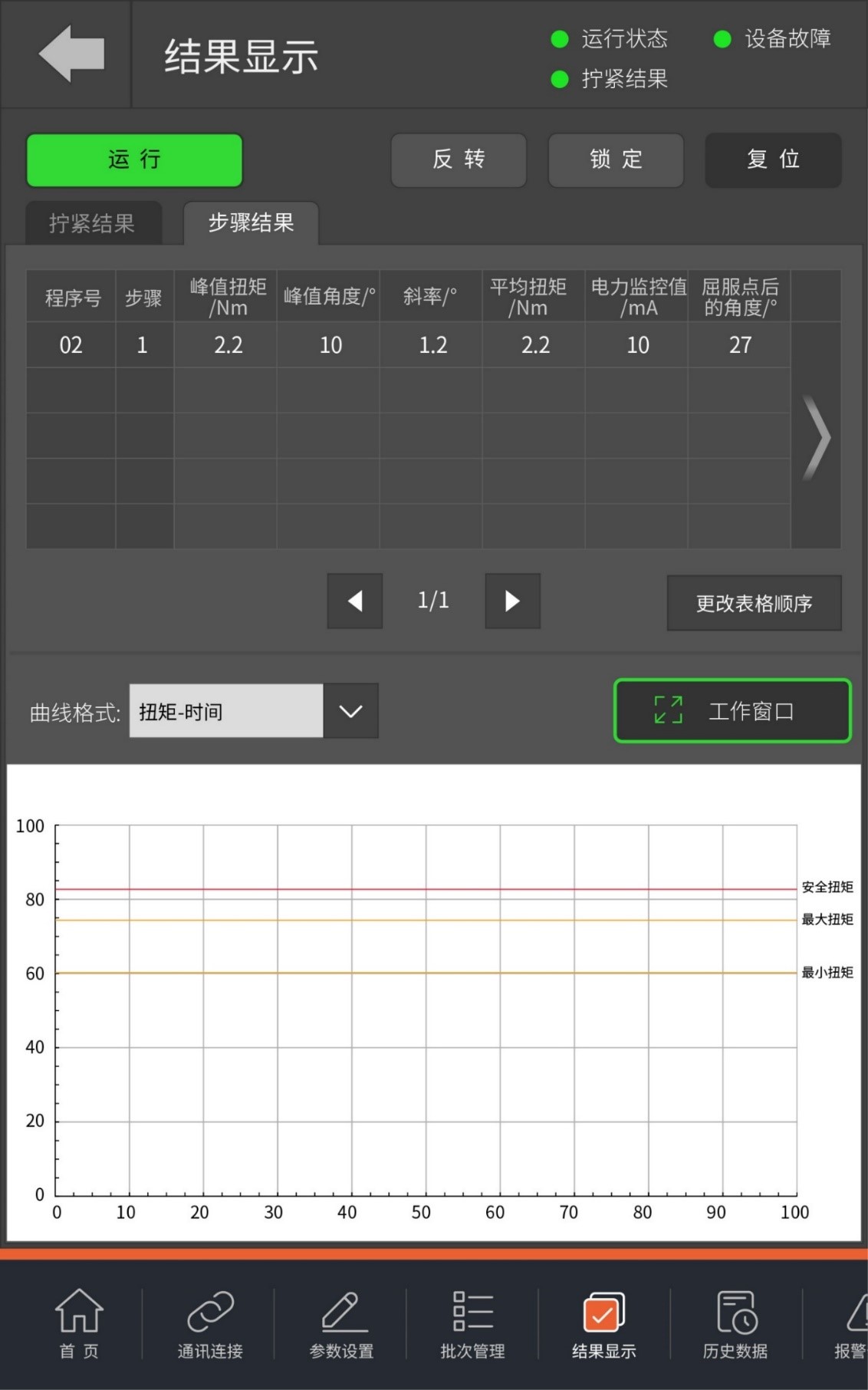
Example tightening result interface showing step data and a torque-time process window.
What an Automotive Torque Traceability Record Should Contain
A useful traceability record should answer six questions without relying on operator memory:
· What vehicle, component or serial number was processed?
· Which joint or fastening point was tightened?
· Which tightening program and limits were applied?
· What torque, angle and cycle result was measured?
· Which tool, station and time were associated with the operation?
· Was the result accepted, rejected, retried or released under an authorized exception?
The required fields vary by plant and risk level. Safety-critical joints may also require tightening curves, calibration status, user identity, rework history and links to production genealogy. The goal is not to collect data for its own sake, but to preserve the evidence needed to verify execution and support corrective action.
How to Strengthen Torque Control at Offline Repair Stations
1 Apply the same quality principles used on the main line. Define approved programs, process limits, permissions and release conditions for offline repair rather than treating rework as an informal manual activity.
2 Link digital completion to a measured OK result. A task should close only after the system receives valid fastening evidence from the assigned tool and program.
3 Control program selection and product matching. Use barcode, VIN, batch or workstation logic where appropriate so the operator receives the correct tightening strategy for the specific repair.
4 Retain sufficient process data. Store the measurements and context required to reconstruct what happened, not only a final “complete” flag.
5 Validate software updates before release. Test normal cycles, skipped operations, NG results, interrupted communication and recovery behavior so workflow changes cannot silently bypass fastening controls.
6 Define exception and rework rules. Require authorized handling for retries, overrides and incomplete operations, and preserve these events in the audit trail.
Torque Data Traceability Is a Core Automotive Quality Control
The Ford 23-vehicle recall demonstrates that a small software logic error can disconnect a digital repair record from the physical tightening process. The central lesson is not limited to one manufacturer: a status field is not proof of a correctly completed joint.
Automotive manufacturers need intelligent tightening systems that control the process, verify the result, interlock abnormal operations and preserve traceable evidence. When these functions extend from the main line to offline repair, rework and service processes, quality teams gain a clearer basis for preventing escape defects and responding precisely when a deviation occurs.
To evaluate an automotive tightening or offline repair application, share the joint specifications, target torque, process sequence, vehicle or component identification method and plant integration requirements with Danikor.
Frequently Asked Questions About Automotive Torque Traceability
What is automotive torque data traceability?
It is the ability to connect each fastening result to the relevant vehicle or component, joint, program, tool, time and OK/NG status so the operation can be verified and investigated later.
Why is a completed repair order not enough?
A completion status may be generated without objective evidence that the required tightening cycle occurred. A controlled workflow should link task closure to a valid measured result.
What did Ford recall 26V550 involve?
The recall covered 23 vehicles. Ford reported that a software coding error in torque repair carts used for offline repairs could allow a task to close without requiring the prescribed torque operation.
Which vehicles were included in the Ford recall?
The potentially affected population included certain 2026 Ford Maverick, F-150 and Bronco Sport vehicles. Owners should use official VIN-based recall tools for vehicle-specific information.
What fastening data should an automotive plant retain?
Common fields include product ID, joint, torque, angle, cycle time, tightening program, tool or station ID, timestamp and OK/NG status. Critical applications may require curves, calibration and rework history.
How do station interlocks reduce tightening errors?
They prevent the process from advancing when a required point is incomplete, the wrong program is selected or the measured result falls outside the defined limits.
Can Danikor tightening systems connect to MES?
Danikor systems can be configured for plant integration. The exact protocol, controller, data fields and MES workflow should be confirmed for the project.