With the continuous iteration and upgrade of intelligent driving and autonomous driving technologies, in-vehicle cameras, as the core perception hardware of intelligent vehicles, are hailed as the "visual eyes" of the entire vehicle's intelligent driving system. They undertake core functions such as road condition acquisition, lane recognition, obstacle monitoring, and driving environment perception. The assembly precision of in-vehicle cameras and the quality of screw fastening directly determine the perception accuracy and operational stability of the intelligent driving system. They are also crucial for ensuring overall vehicle driving safety and extending the service life of components.
Unlike ordinary automotive parts, the assembly of in-vehicle camera modules, lenses, and housings uses M1-M3 micro precision screws. These are characterized by small screw specifications, short fastening travel, extremely low assembly tolerance, and stringent accuracy requirements, imposing higher demands on the stability, precision, and controllability of automatic fastening equipment.
Traditional manual fastening and ordinary semi-automatic screw driving equipment struggle to adapt to the precision assembly scenarios of in-vehicle cameras. During production, they are highly prone to various defects such as screw jamming, crooked screws, missing screws, missed fastening, false fastening, torque deviation, and thread damage. Assembly flaws can cause camera module looseness, displacement, sealing failure, and water ingress damage, subsequently leading to perception failures, image shift, functional errors, and other faults in the intelligent driving system, creating serious driving safety hazards.
Simultaneously, traditional operation modes also suffer from many industry pain points, including low production efficiency, poor product consistency, lack of retained fastening data, non-traceable quality, and large fluctuations in yield rate. Therefore, establishing a high-precision automatic screw driving system suitable for in-vehicle micro-screws, achieving standardized control across the entire process of feeding, screw pick-up, fastening, and quality control, has become a core necessity for in-vehicle camera manufacturers to improve quality and efficiency, strictly control quality, and meet automotive-grade standards.
I. Core Industry Pain Points in Automotive Camera Screw Fastening
Core processes such as in-vehicle camera module assembly, lens fixation, and housing encapsulation commonly use M1-M3 ultra-small precision screws. The assembly scenario for these micro-screws is highly specific. Traditional vibrating bowls, blow-feed screw feeders, and ordinary fastening equipment are entirely incapable of meeting mass production demands. The industry has long faced four major core fastening quality challenges:
• Poor Feeding Stability, Frequent Screw Jamming and Damage: Traditional blow-feed and vibrating bowl feeders have extremely poor adaptability for M1-M3 micro-screws. High-speed production often leads to screw stacking, overlapping, jamming, feeding stalls, and sorting errors, requiring frequent shutdowns for maintenance and rework, severely disrupting production rhythm. Additionally, the strong vibration and rigid compression of these feeding methods can easily damage the threads and surface coatings of the micro-screws, implicitly increasing the risk of assembly defects and product scrap costs.
• Pick-and-Place Misalignment, High Rate of Crooked and Dropped Screws: Due to the extremely small size and light weight of in-vehicle micro-screws, traditional mechanical grippers suffer from uneven clamping force and poor centering effect. During screw pick-up and positioning, issues like screw misalignment, tilting, and dropping frequently occur. If the equipment lacks anomaly detection and forcibly fastens crooked or misaligned screws, it directly leads to thread damage, screw hole collapse, or module housing cracking, resulting in immediate scrap of the camera finished product and significantly increasing production costs.
• Insufficient Tightening Precision, Difficult to Guarantee Batch Consistency: Ordinary electric screwdrivers have coarse torque control accuracy and large error margins, making them unable to meet the micro-torque fastening requirements for precision camera assembly. Production often faces issues where loose fastening causes camera module looseness and jitter during driving, or over-tightening leads to plastic housing cracking and thread damage. The poor consistency of batch product fastening fails to meet the standardized mass production requirements for automotive components.
• Lack of Data Traceability, Failure to Meet Automotive-Grade Quality Control Standards: Traditional fastening equipment can only perform basic tightening actions without data acquisition, recording, or storage functions. They cannot monitor core parameters like tightening torque, angle, and status in real time. Once product quality issues arise, it is impossible to trace the production process or pinpoint the cause of failure. This entirely fails to meet the full-process traceability requirements of the automotive industry's IATF 16949 quality system, hindering production line quality control, process improvement, and OEM qualification audits.
II. DaniKor's Full-Process Solution: Precisely Solving Camera Fastening Challenges
With years of deep involvement in the automotive precision assembly field, DaniKor precisely understands the industry pain points and automotive-grade production requirements for fastening micro-screws in in-vehicle cameras. We have developed a targeted, integrated automatic screw driving solution featuring disc stable feeding + vacuum suction screw pick-up + intelligent servo electric screwdriver fastening + full-link data traceability. This entire system provides layered safeguards and full-process control across four core stages: feeding, screw pick-up, fastening, and quality control. It solves issues like micro-screw jamming, crooked screws, poor accuracy, and lack of traceability, perfectly adapting to the standardized, high-precision, high-yield mass production needs of in-vehicle cameras.
(A) Disc Screw Feeder: Stable 0-Jam Feeding, Adaptable to Micro-Screws
Stable feeding is the first checkpoint for ensuring fastening quality and mass production rhythm. To address the pain points of micro-screws used in in-vehicle cameras—being prone to jamming, deformation, and thread damage—DaniKor has abandoned traditional vibrating bowl and blow-feed structures. Instead, we employ our independently developed high-precision disc screw feeder, which fundamentally optimizes the feeding logic for micro-screws through its hardware design.
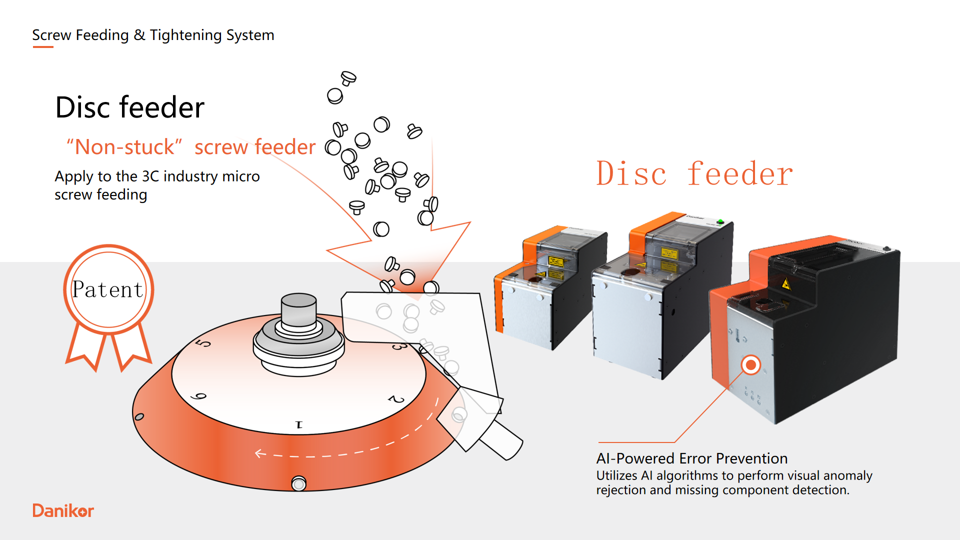
The DaniKor disc screw feeder uses a motor to drive a waterwheel-type feeding mechanism that continuously delivers screws to the top of the turntable. Below the turntable, a vacuum generator creates negative pressure to suction and pick up screws, achieving a stable feeding effect with zero jams. This continuous and stable output of qualified screws lays a solid foundation for subsequent precise fastening, effectively improving the overall yield rate and production efficiency of the production line.
(B) Vacuum Suction Pick-Up Structure: Precise Alignment, Eliminating Crooked and Dropped Screws
The pick-up accuracy and vertical alignment of micro-screws directly determine whether the fastening is qualified and are the core link in preventing crooked and false fastening. Traditional mechanical grippers, with their uneven clamping force and poor centering accuracy, are a primary cause of crooked screws, dropped screws, and misalignment in micro-screw assembly. To this end, DaniKor has specifically optimized the pick-up process, adopting an integrated solution of vacuum suction for screw pick-up + real-time negative pressure monitoring, perfectly suited for the precise pick-up of in-vehicle micro-screws.
The equipment uses uniform and stable vacuum negative pressure to suction the screws, ensuring even contact force without damaging the threads or surface coatings. It is also equipped with an intelligent alignment mechanism that automatically corrects the screw angle, ensuring that every screw is vertically aligned and accurately enters the hole, fundamentally preventing misalignment fastening issues.
(C) Intelligent Servo Electric Screwdriver: High-Precision Fastening, Ensuring Assembly Consistency
Fastening precision is the core key to controlling the fastening quality of in-vehicle cameras. In-vehicle cameras often have thin plastic housings and precision module structures with low compression and torque resistance. Their tolerance for fastening torque errors is extremely low; a deviation of just 0.01 N·m can cause fatal defects such as housing cracking, thread damage, or loose fixation. DaniKor's complete fastening system is equipped with a high-precision intelligent servo electric screwdriver, designed to meet automotive-grade precision assembly standards, achieving micro-torque, high-precision, and high-consistency intelligent fastening operations.

This intelligent servo electric screwdriver offers torque control accuracy up to 6σ ±5%, supporting precise micro-torque adjustment that perfectly matches the fastening parameters of in-vehicle camera micro-screws, precisely avoiding quality issues like loose fastening or over-tightened cracked housings. The device also incorporates a self-developed intelligent fastening algorithm that collects and analyzes multi-dimensional data—including tightening torque, angle, and speed—in real time throughout the process. It can automatically identify various non-conforming conditions such as screw idle running, thread damage, incomplete fastening, torque attenuation, false fastening, and missed fastening. It determines fastening results in real time, significantly reducing manual quality inspection costs and errors.
III. Conclusion
As the core safety perception component of intelligent driving systems, the screw fastening precision and assembly quality of in-vehicle cameras directly impact overall vehicle driving safety and allow no room for error. Traditional manual fastening and ordinary automatic fastening equipment, suffering from insufficient precision, poor stability, and lack of data traceability, can no longer meet the high-precision, high-reliability, automotive-grade mass production assembly requirements of today's intelligent vehicles.
DaniKor, with deep expertise in the automotive precision tightening and assembly field, focuses on the niche scenario of fastening micro-screws for in-vehicle cameras. We have developed a dedicated, integrated automatic screw driving solution. Through four core technological advantages—stable feeding, precise screw pick-up, intelligent fastening, and full-process traceability—we have established a closed-loop quality control system across the entire process. This ensures fastening precision, product consistency, and mass production stability from the source of production, thoroughly solving core industry pain points such as low yield rates, poor production efficiency, difficult quality control, and lack of traceability. This solution builds a solid assembly foundation for the high-precision, automotive-grade, large-scale production of intelligent driving in-vehicle components.