From Manual Screw Picking and Tightening to Automatic Screw Feeding and Tightening
In the current era of large-scale smart manufacturing implementation, the cycle time stability and production efficiency of assembly lines directly determine a company's competitiveness in mass production. Currently, most traditional manufacturing assembly lines still commonly use manual screw picking, manual alignment, and handheld tool tightening. These seemingly simple processes have become core bottlenecks restricting line cycle time acceleration and production capacity upgrades.
The random errors, operational delays, and quality risks associated with manual screw picking lead to chaotic line cycles, fluctuating yield rates, and difficulty in meeting production targets. Danikor's automatic screw feeding and tightening solution precisely targets these core pain points. Through full-process automation upgrades, it enables the transformation from inefficient manual operations to intelligent, efficient assembly, comprehensively optimizing line cycle times. This empowers companies to reduce costs, increase efficiency, and improve quality and speed.
I. Manual Screw Picking: The Core Bottleneck Restricting Assembly Line Cycle Time
In traditional screw assembly processes, manual screw picking is the most overlooked yet highly impactful inefficient link. The complete manual operation workflow involves: the operator grabbing a screw box → sorting and selecting acceptable screws → manually holding the screw to align with the hole → tightening with a handheld electric screwdriver → checking for missed or floating fastenings. This entire process heavily relies on manual operation, and multiple issues directly disrupt the standard line cycle time.
Significant Fluctuation in Operational Efficiency, Cycle Time Cannot Be Constant
The speed of manual screw picking is greatly influenced by the worker's skill level, fatigue, and mood. Time differences between new and experienced workers are obvious, and productivity fluctuations between morning and night shifts are prominent. Manual actions like searching for screws, dropping them due to unstable grip, and repeated alignment generate a significant amount of non-productive time. Overtime at a single station directly causes material buildup and waiting on the line, disrupting the flow rhythm of the entire assembly line and making it unable to meet the demands of large-scale, standardized mass production.
Secondary Cycle Time Loss Caused by Human Error
Manual operations are highly prone to issues such as screw mixing, missed picking, dropped screws, and alignment errors. During the tightening phase, problems like floating fastenings, stripped threads, and false tightening commonly occur. When defective products flow to downstream processes, they necessitate rework or repair, causing several times more line stoppage time than normal operations and significantly reducing overall equipment effectiveness (OEE).
High Labor Costs and Insufficient Mass Production Stability
Screw fastening is a high-intensity, repetitive task. Staff turnover and ongoing pre-job training continuously increase management costs. Manual operations do not allow for data-driven control; the line cycle time can only passively adapt to human efficiency. This makes precise production planning and stable capacity expansion difficult, seriously hindering a factory's smart manufacturing upgrades.
II. Automatic Screw Feeding and Tightening: The Core Upgrade Solution for Cycle Time Optimization
To address the various cycle time challenges posed by manual screw picking, Danikor, with deep expertise in the intelligent tightening field, has developed an integrated automatic screw feeding and tightening solution. This solution eliminates manual intervention steps, achieving a fully automated process that includes automatic screw sorting, automatic conveying, precise positioning, intelligent tightening, and data traceability. It fundamentally eliminates the uncertainties of manual work, solidifies standard production cycle times, and significantly improves assembly efficiency and production stability.
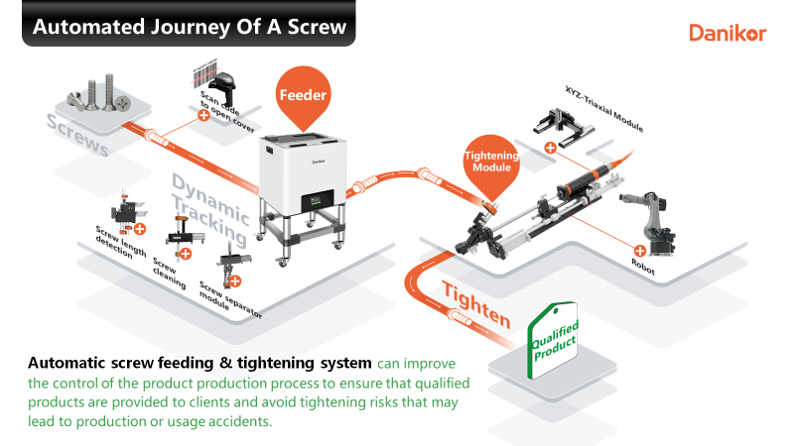
Addressing the low-efficiency pain points of the entire manual process, Danikor's integrated automatic screw feeding and tightening system combines core units such as screw feeders, tightening modules, moving mechanisms, and intelligent tightening tools. This enables a fully automatic, closed-loop operation from the screw hopper to the completion of fastening. It removes redundant steps like manual screw picking, sorting, and alignment, eliminating human-induced variability at the source and stabilizing the standard production cycle time. Throughout this process, the system can perform dynamic tracking, enhancing control over the product production process and ensuring product quality.
Automatic Feeding and Sorting, Orderly Screening of Screws
Workers only need to periodically add screws in bulk to the feeder hopper; the system automatically handles screw organization. Danikor offers different types of feeders—vibratory, stepped, and turntable—to suit various working conditions:
Vibratory feeders are suitable for standard small screws (M2-M6) in high-volume mass production for faster cycle times.
Pusher-type (stepped) feeders produce no vibration debris and are suitable for larger screws (M2-M24), commonly used in automotive parts production lines, with a standard screw jamming rate as low as 50 PPM.
Turntable feeders are specially designed for micro screws, achieving a jamming rate close to 0 PPM.
Clamping and Aligning the Screw, Driving the Fastening Operation
The tightening module is the core unit connecting the feeding system and the tightening tool. It performs two key tasks: First, after the screw is conveyed to the bit, it uses clamping jaws to hold and align the screw with the workpiece hole. Second, it uses a built-in power source (cylinder or motor) to lower the tightening tool and execute the fastening. The structural design of this module must fully consider the screw specifications and application conditions. For example, with a blow-and-vacuum module, the appropriate bit structure must be selected based on the screw's length-to-diameter ratio.
Automatic Positioning and Tightening with Servo Precision
A 3-axis moving platform or 6-axis robot guides the tightening module to accurately reach the screw hole position, replacing the manual alignment action. The servo-controlled intelligent tightening tool then initiates fastening, with closed-loop monitoring of torque, speed, and angle throughout the process. Torque precision reaches 6σ ±5%, and the tool automatically stops upon reaching the set torque, effectively preventing floating fastenings and stripped threads.
III. Value of Process Upgrading: From Cycle Time Optimization to Overall Production Capacity Enhancement
The process innovation from manual screw picking to Danikor's automatic feeding and tightening is not just an efficiency upgrade at a single station, but a comprehensive enhancement of the entire assembly line's production capacity, quality, and cost-efficiency. The core problem with manual picking is "human uncertainty," while the core advantage of the automation solution is "standardized stability." By solidifying the conveying and tightening rhythm for each screw and eliminating operational deviations, the line flow becomes smoother, production output more stable, and product quality more uniform.
In summary, the issues of lagging cycle time, unstable efficiency, and quality fluctuations caused by manual screw picking on assembly lines have long been a common weakness restricting mass production and quality improvement in manufacturing. Abandoning traditional manual picking and tightening models and implementing Danikor's automatic screw feeding and tightening solution represents the most efficient and practical transformation method currently available for cycle time improvement and capacity upgrade at assembly stations. Through a standardized automatic feeding, intelligent precision fastening, and fully data-controllable operational model, it thoroughly resolves the uncertainty of manual operations, effectively compresses assembly time, stabilizes production cycles, reduces losses from defects and rework, and helps manufacturing enterprises across various industries achieve standardized quality improvement, efficient production increase, and cost-effective benefits, laying a solid foundation for the intelligent upgrade of production lines.