Flexible Feeding System Solves the Feeding Difficulty of Materials with Minimal Differences
In the current era of rapid smart manufacturing development, flexible feeding technology has become the core hub connecting material processing and automated production lines, directly determining the upper limits of production efficiency and product quality. It is widely used across multiple core manufacturing fields such as electronics, automotive, and medical. However, in actual production scenarios, many companies face the same tricky problem: when dealing with materials that have extremely small differences between their front and back sides (e.g., microelectronic components, automotive battery electrodes, precision springs, etc.), traditional flexible feeding vision recognition methods rely on manually selecting feature points. This is not only time-consuming and labor-intensive but also prone to misidentification and missed identification. Consequently, this leads to material waste, production line downtime, and a decline in product yield, becoming a "stumbling block" restricting enterprises' intelligent upgrades.
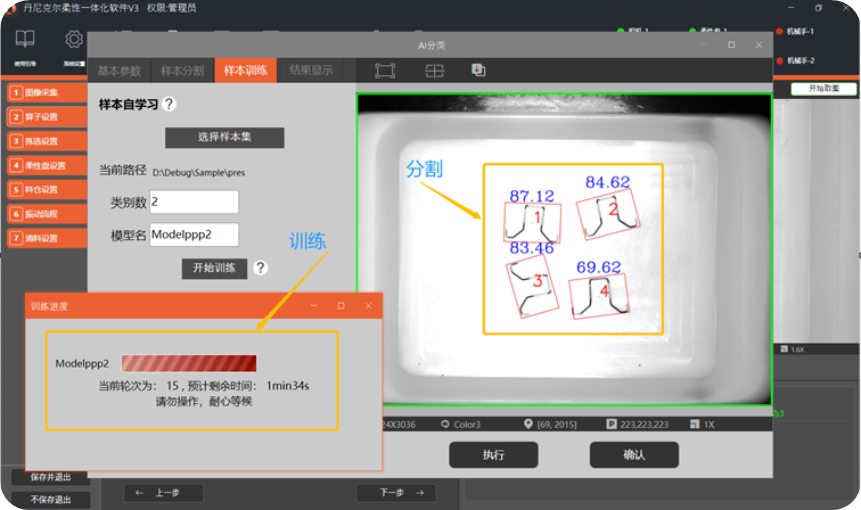
Addressing this industry pain point, Danikor's flexible feeding system innovatively incorporates a self-developed AI intelligent algorithm, breaking through the limitations of traditional vision recognition. It provides an efficient and precise solution for the flexible feeding of materials with minimal front-back differences, helping enterprises solve feeding difficulties and achieve production line cost reduction and efficiency improvement.
The pain point of traditional flexible feeding recognition is essentially a dual dilemma of "human reliance" and "insufficient precision." For materials with highly similar front and back structures and subtle differences, traditional vision recognition requires operators to manually calibrate feature points. This not only demands significant manpower costs but is also easily affected by human operational errors, changes in ambient light, material placement angles, and other factors, leading to unstable recognition accuracy and a persistently high false recognition rate. Especially in small-batch, multi-variety production scenarios where material specifications are switched frequently, the process of manually recalibrating feature points is cumbersome, significantly slowing down the production line cycle time and making it difficult to meet the high-efficiency demands of smart manufacturing.
The core breakthrough of Danikor's flexible feeding system lies in the deep integration of AI intelligent algorithms with flexible feeding vision guidance technology, using "AI self-learning" to replace "manual calibration" and solving the recognition problem for materials with minimal front-back differences. The operation process is simple and easy to understand, requiring no professional algorithm background, and can be quickly mastered by ordinary operators.
First, create two category sample folders and collect a certain number of image samples of the front and back sides of the material respectively, covering different placement positions and angles to ensure comprehensive samples. After sample collection is completed, the system can start model training with one click. Through deep learning technology, the AI algorithm automatically extracts subtle feature points of the material in different postures, autonomously optimizes the recognition logic, and establishes a high-precision recognition model, significantly improving the stability and accuracy of correct posture recognition while effectively avoiding errors caused by manual operation.
To further enhance recognition stability, Danikor also uses optical optimization technology to "safeguard" AI recognition – employing a customized top lighting system to achieve uniform illumination on the material surface, visually "amplifying" subtle front-back differences. A professional light-absorbing cloth is pasted on the tray surface to effectively absorb ambient stray light and eliminate bottom reflection, ensuring the captured images are clear and complete, providing a high-quality data analysis foundation for the AI algorithm and further improving recognition accuracy.
In the current manufacturing landscape shifting towards "small batches, multiple varieties, and fast delivery," the precision and efficiency of flexible feeding directly determine a company's core competitiveness. Danikor's flexible feeding system, with its self-developed AI intelligent algorithm at its core for vision guidance, has successfully solved the recognition problem for materials with minimal front-back differences. It not only addresses the efficiency bottleneck of traditional feeding but also reduces labor and material costs, providing strong support for enterprises' intelligent upgrades.