How Can a Wireless Angle Head Screwdriver Solve the Assembly Pain Points in Automotive Final Assembly?
Among the four major processes in modern automobile manufacturing, the final assembly workshop is the link with the densest personnel, the most complex processes, and the highest requirements for flexibility. A car is often composed of tens of thousands of parts, and the quality of bolt connections directly relates to the safety and reliability of the entire vehicle. This article will delve into the common assembly pain points in the automotive final assembly stage and analyze in detail how wireless angle head screwdrivers can resolve these production challenges.
I. Core Assembly Pain Points on Automotive Final Assembly Lines
1. Confined and Narrow Spaces, Traditional Tools are Hard to Maneuver
The internal structure of a car is compact, especially in areas like the chassis, inside the engine compartment, door interior panels, and under the seats, where bolts are often located in extremely hidden or narrow corners. Traditional straight-handle tightening tools or bulky pneumatic/corded electric screwdrivers, due to their large head size or long body, simply cannot reach these confined spaces to operate from a vertical perspective, easily leading to bolts being driven in crooked or not being locked properly.
2. Severe Cable Restrictions, Affecting Efficiency
Traditional tightening systems typically consist of a controller, heavy cables, and the screwdriver gun. On the final assembly line, workers need to frequently walk around the vehicle body. The long, trailing cables are not only a tripping hazard, posing safety risks, but can also easily scratch the expensive automotive paint during movement. Furthermore, the physical constraints of the cables significantly reduce the flexibility of workstation layout.
3. Data Interruptions and Risks of Traceability Gaps
Modern automakers strictly require a "one vehicle, one file" policy, meaning key torque data must be 100% uploaded to the MES (Manufacturing Execution System) for long-term storage and traceability. However, factory environments are complex, and wireless network signals often have blind spots. If the tool loses tightening data at the moment the network disconnects, it can break the traceability chain, which is absolutely unacceptable under quality management systems.
II. How Does the Wireless Angle Head Screwdriver Precisely Solve These Problems?
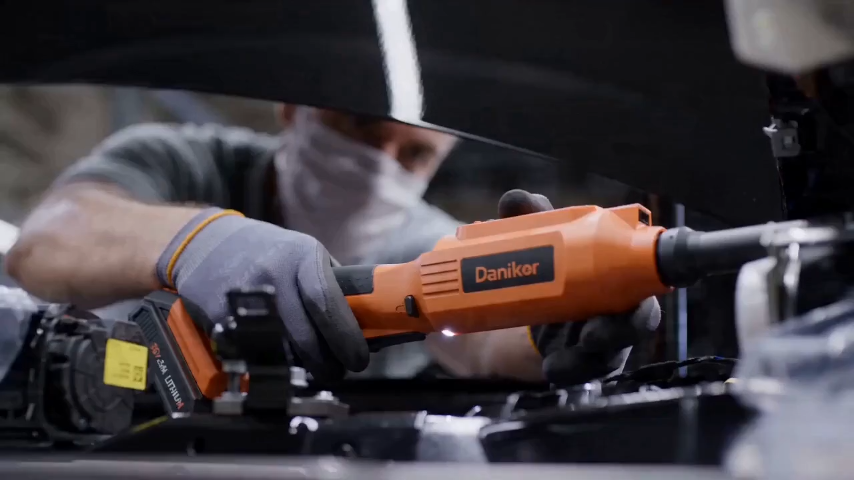
Addressing the above pain points, Danikor's TBD/TBE series wireless angle head screwdrivers offer a reliable solution set with their innovative structural design and software-hardware integration.
1. Angle Head Design and Minimalist Body: Specially Designed for Confined Spaces and Cable Restrictions
The most obvious advantage of the wireless angle head screwdriver is the "90-degree angle head" design at the front. This design allows it to easily reach into confined spaces—like chassis suspensions and interior corners—that straight screwdrivers cannot access, enabling precise horizontal or lateral torque application. At the same time, the wireless angle head screwdriver completely eliminates the constraints of cables. This not only removes the risk of cables scratching the paint but also grants workers great "wireless freedom." Whether working inside or outside the vehicle, the tool is lightweight and flexible, significantly improving efficiency across multiple workstations.
2. Data Loss Prevention and Built-in Barcode Scanning: Building a Traceability System with No Blind Spots
Addressing the pain point of data loss, high-end wireless angle head screwdrivers have made revolutionary upgrades in data communication.
Offline Data Protection and Independent Use: They support independent use even when the network is disconnected. The tool securely stores tightening data in its high-speed onboard cache. Once the WiFi signal is restored, the wireless angle head screwdriver will automatically upload all data generated during the disconnection period to the MES system, ensuring worry-free traceability and complete data integrity.
Built-in Barcode Scanning Function: The tool body has a built-in barcode scanning module. Workers only need to scan the vehicle or component barcode, and the wireless angle head screwdriver will automatically load the corresponding program. This eliminates the need for external scanning equipment, truly offering a "plug-and-play" experience and simplifying program switching during mixed-model production.
3. High Precision and Rugged Construction: Ensuring Assembly Quality and Equipment Durability
Automotive final assembly demands extremely high torque accuracy. This wireless angle head screwdriver excels across its entire torque range: achieving 6σ accuracy of ±5% in standard mode and maintaining 6σ accuracy of ±7.5% even in pulse mode. Furthermore, considering the complex factory environment, its structure has been reinforced:
Drop Resistance: Tools are inevitably subject to bumps. This tool has passed multi-angle 1.5-meter drop tests, operating normally even after impact.
Durable and Long-Lasting: Its reinforced body structure ensures high precision stability, capable of withstanding up to 500,000 durability tightening cycles, providing peace of mind for maintenance.
Long Battery Life: Battery technology is crucial for wireless tools. It supports up to 8,020 continuous tightening cycles (for the 36V version) or 2,500 cycles (for the 18V version), ensuring more reliable continuous assembly and reducing time lost to frequent battery changes.
In summary, Danikor's wireless angle head screwdriver is no longer just a simple tool, but a smart assembly terminal that highly integrates intelligent control, data transmission, ergonomics, and precision mechanics. It perfectly aligns with the pain points of the automotive final assembly industry: conquering confined spaces with the "angle head," eliminating cable constraints with "wireless integration," and preventing traceability gaps with "offline data caching." This helps automakers significantly improve assembly efficiency and reduce defect rates.