As industries such as automotive and aerospace increasingly demand lightweight solutions, composite materials like carbon fiber are being widely adopted. However, fastening composite materials imposes higher requirements on the tightening process.
Traditional tightening methods struggle to balance precision and stability, whereas the servo fastening module, with its precise control capabilities, is becoming a key solution for composite material assembly.
1. Main Challenges of Fastening Composite Materials
During the assembly of composite materials, common issues include:
High material brittleness and sensitivity to impact
Weak interlaminar bonding strength, prone to delamination
Susceptibility to cracking, thread stripping, and other defects under pressure
Extremely high requirements for pressure control and consistency
If the tightening process is not properly controlled, it will directly impact the structural reliability and service life of the product.
2. Limitations of Traditional Pneumatic Fastening Modules
Common pneumatic-driven fastening solutions currently available have notable shortcomings in composite material applications:
High impact force: Instantaneous loading can easily damage the material
Unstable pressure: Affected by fluctuations in the air source, resulting in poor repeatability
Limited control capability: Difficult to achieve refined process control
Therefore, traditional solutions struggle to meet the high-consistency, low-damage assembly requirements of high-end manufacturing.
3. Core Advantages of the Servo Tightening Module
Accurate multi-stage pressure control: For machine screws and softer threaded holes (e.g., aluminum, copper), the pressure can be dynamically and precisely adjusted. The screwdriver bit exerts no impact during tightening, avoiding issues common with traditional modules such as excessive and non-adjustable pressure leading to thread damage, product scrapping, or the bit jumping out. Multi-stage pressure control ensures an impact-free tightening process.
Improved efficiency without compromising quality: Compared to traditional pneumatic solutions, the servo electric drive control allows the servo system to increase the overall cycle rate by approximately 25%–30%. This enhances production efficiency while maintaining quality, achieving both speed and stability.
Highly integrated system: The module and tool can exchange information via a PLC, enabling interactive control between displacement, thrust, tightening speed, and torque. This results in a more efficient, precise, and stable tightening process.
Streamlined structure: The compact size reduces the footprint by 43% compared to traditional pneumatic cylinder modules, saving equipment space and allowing for more flexible workstation layouts.
Standoff error detection: Position detection can identify standoff issues, effectively aiding in the detection of such problems without the need for additional displacement sensor equipment.
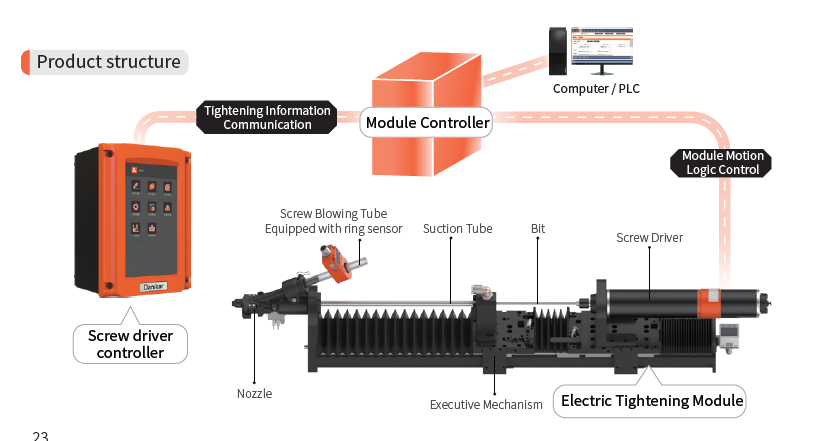
As manufacturing evolves towards high precision and intelligence, traditional tightening methods are no longer adequate for composite material assembly requirements.
The servo tightening module, with its precise pressure control and impact-free fastening capability, not only improves assembly quality but also drives the upgrade of tightening processes towards digitalization and intelligent control.