In modern industrial assembly scenarios, the torque screwdriver (often referred to as an electric screwdriver or electric tightening tool) is critically important. Whether it is a car speeding on the highway or a smartphone held in hand, the structural stability behind them relies on the ultimate pursuit of tightening accuracy. This article will explain how to choose the accuracy of a torque screwdriver based on process requirements and cost-effectiveness.
Industrial assembly typically classifies tightening points into three levels. To select a suitable torque screwdriver, you must first “classify” the workstation.
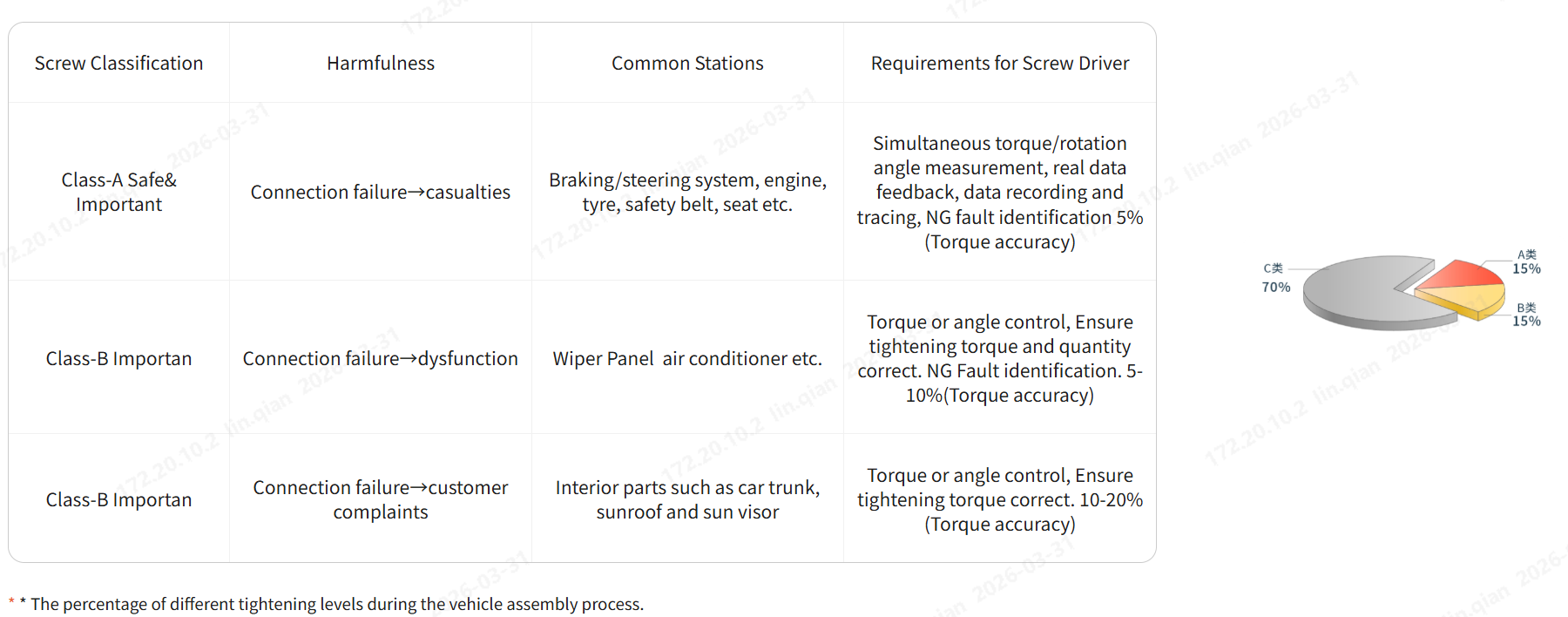
1. Class A – Safety Critical: Error < 5%
Typical components include engine cylinder head bolts, car seat belt anchor points, suspension systems, battery packs, etc. Failure at these workstations often means catastrophic safety incidents, requiring the use of high-precision sensor-type torque screwdrivers.
Technical Core: These torque screwdrivers are equipped with built-in expensive torque sensors and angle encoders. Instead of relying on current estimation, they use physical sensors to directly measure the deformation of the output shaft.
Dual Control Strategy: They employ a “torque + angle” dual monitoring system. If either parameter does not meet the standard, the torque screwdriver will immediately issue an alarm, effectively identifying hidden issues such as thread stripping, missing washers, or excessively long bolts.
Digital Traceability: The tightening curve for each bolt is recorded in real-time and uploaded to the MES (Manufacturing Execution System).
2. Class B – Important: Error 5% – 10%
Typical components include windshield wiper motors, automotive air conditioning compressor mounts, and large interior parts. Although these components do not directly affect driving safety, they do affect the vehicle’s normal functionality. Poor accuracy can lead to abnormal noise, air leaks, or fluid leaks. This category typically requires a current-control torque screwdriver, which calculates torque by monitoring current changes during motor operation. While its accuracy is slightly lower than that of a sensor-type tool, it eliminates the need for expensive sensor hardware, offering a cost advantage. For most functional assembly tasks, a current-control torque screwdriver, combined with scientific algorithm compensation, is sufficient.
3. Class C – Standard: Error 10% – 20%
Typical components include wire harness brackets, sun visors, interior trim panels, and some plastic parts. The principle here is to “install and ensure no fall-off.” There is no need for expensive servo torque screwdrivers; clutch-type electric tools or pneumatic tools are sufficient. These rely on a mechanical spring clutch that slips when the set torque is reached, stopping the bit from rotating. Although they cannot provide data monitoring, their advantages lie in simple structure and extremely low maintenance costs.
When selecting a torque screwdriver, in addition to looking at the accuracy percentage in the specifications, the following three dimensions should also be considered:
1. The Value of Data Traceability
If a factory is transitioning towards “Industry 4.0,” accuracy itself may not be the sole consideration; data collection capability becomes crucial. The digital nature of a sensor-type torque screwdriver allows you to precisely identify which day, which shift, and which bolt caused an issue when quality complaints arise years later. This risk mitigation capability is something that clutch tools cannot provide.
2. Step-by-Step Tightening and Error Proofing
At the moment the bolt contacts the joint surface (the snug point), a high-precision torque screwdriver can rapidly decelerate to prevent torque overshoot caused by inertia. This control over the tightening rhythm is also an important aspect of accuracy.
3. Maintenance and Calibration
Accuracy has a “timeliness” factor. An excellent torque screwdriver must possess good stability. Typically, clutch tools require more frequent spot checks and calibration, while sensor-type tools can maintain consistency over longer periods.
Choosing the accuracy of a torque screwdriver is essentially finding a balance among quality risk, production efficiency, and investment cost. Excessive pursuit of high precision can lead to redundant equipment investment, while neglecting the accuracy of critical workstations can result in frequent product quality issues. For industries such as automotive, aerospace, and medical devices, it is recommended to resolutely choose sensor-type torque screwdrivers for core workstations. For general electronic consumer goods assembly, current-control tools are often the most cost-effective solution.