In automated production lines such as those in automotive OEM plants and home appliance manufacturing, screw feeding is the core prerequisite step for the tightening process, directly determining assembly efficiency and product qualification rate. Manual feeding is not only time-consuming and labor-intensive but also prone to problems like missed feeding, incorrect feeding, and material jamming. In contrast, an automatic screw feeder achieves automatic sorting, inspection, and conveying of screws through automated structural design, solving the pain points of manual feeding. As a professional brand in the field of automatic feeding, Danikor's screw feeders, with their precise structural design and stable performance, are widely used in automotive OEM plants and supporting industries, becoming core auxiliary equipment for intelligent production lines in OEMs. Their working principle meets the precision assembly needs of multiple industries, balancing high efficiency and accuracy.
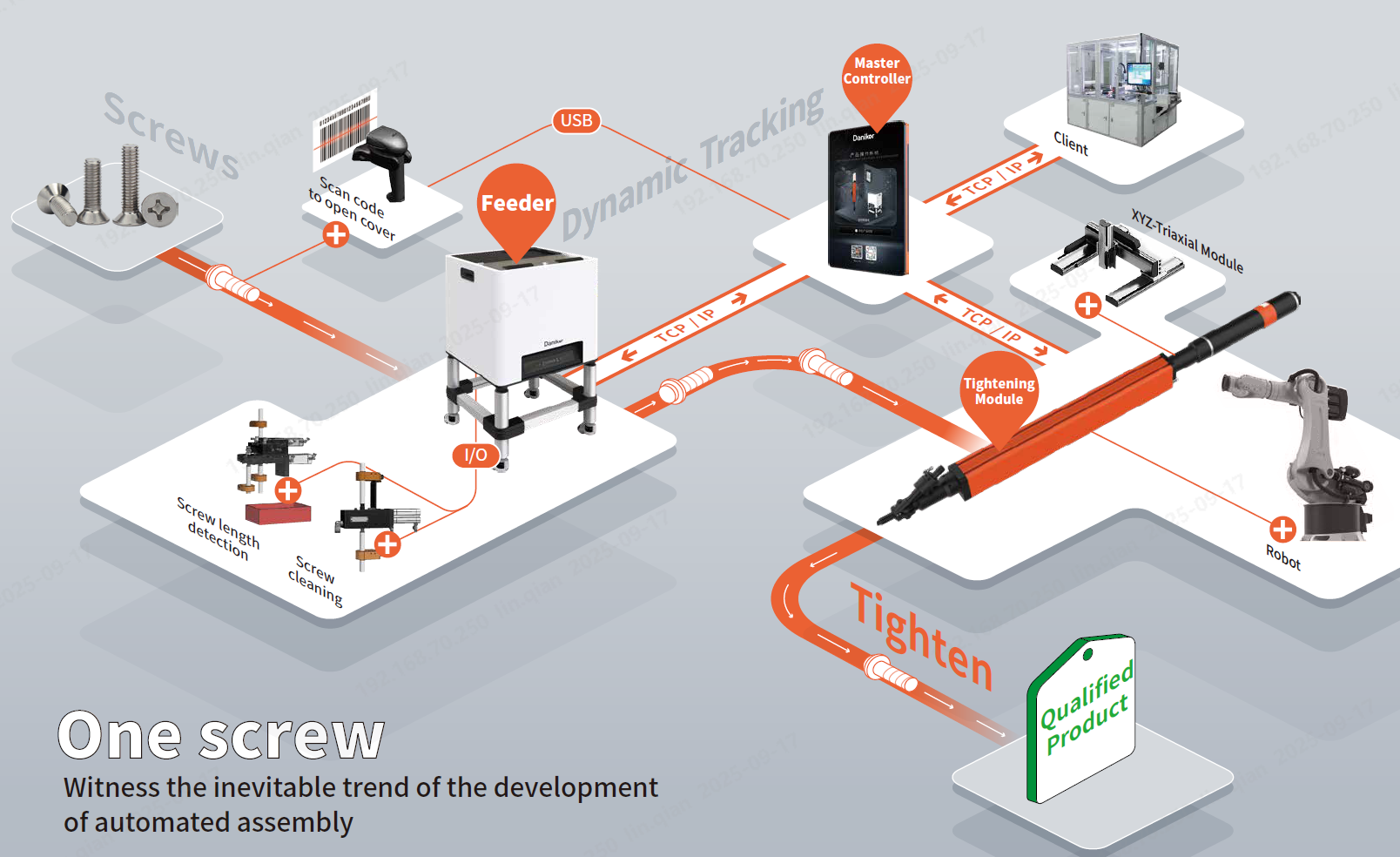
The core working logic of a screw feeder is "automatic sorting → precise inspection → stable conveying." The entire process requires no human intervention, achieving efficient screw feeding through the coordinated operation of multiple components. Its detailed working principle can be divided into four core steps, each closely linked to ensure feeding stability and accuracy.
The first step is feeding and preliminary sorting, which is the foundation of screw feeding. The operator only needs to bulk-pour loose screws into the feeder's hopper. A vibratory bowl is connected below the hopper. The bowl uses a built-in electromagnetic vibrator to generate high-frequency micro-vibrations. Utilizing the centrifugal force from the vibration and the guidance of the track, the initially disordered bulk screws climb along a spiral track. During this process, under the effect of the track's limiting structures, the screws automatically adjust their posture to achieve a uniform orientation (head up, thread down), avoiding issues like tangling or inverting. Danikor's screw feeders, targeting the different specifications and special-shaped screws commonly used in automotive OEM plants, optimize the vibratory bowl track design. They feature an anti-tangling slotted structure and allow precise adjustment of vibration amplitude and frequency via a knob, flexibly controlling the feeding speed to adapt to different tightening tact time requirements, avoiding jamming due to overly fast feeding or affecting assembly efficiency due to overly slow feeding.
The second step is separating and posture calibration, ensuring screws are conveyed in an orderly manner. After being sorted by the vibratory bowl, the screws enter a linear track one by one. A separating mechanism is set at the end of the linear track. Driven by a cylinder or motor, this mechanism separates the screws one by one, preventing multiple screws from entering the feeding tube simultaneously and causing blockage. At the same time, a high-precision photoelectric sensor is installed at the separating mechanism to detect the posture and specifications of the screws in real-time. If a screw that is inverted, deformed, or does not meet specifications is detected, it is automatically rejected into a waste box, preventing incorrect feeding at the source and ensuring that all screws entering the next stage meet assembly standards. This design is particularly well-suited to the stringent quality requirements of automotive OEM plants, preventing tightening failures caused by abnormal screw posture. For example, screw assembly in key areas like automotive chassis and engines demands very high posture accuracy; Danikor's separating and calibration design effectively avoids such risks.
The third step is inspection and stable conveying, building a quality defense line for feeding. After separation and calibration, the screws enter the feeding tube. The inner wall of the tube is made of smooth, wear-resistant material to reduce friction during screw conveying and avoid scratching the threads. Multiple sensors are placed at intervals along the tube to detect the conveying status of the screws in real time. If an abnormality occurs, such as a tube blockage or screw absence, the sensors immediately send a feedback signal. The feeder automatically pauses operation and issues an audible and visual alarm, alerting the operator to address the issue promptly, avoiding impact on the production line's progress. Danikor's screw feeders use a blow-feed conveying method, utilizing a stable airflow to blow the screw at a constant speed to the tightening module. The airflow level can be flexibly adjusted based on screw specifications, ensuring both fast conveying and preventing the airflow from being so strong that it alters the screw's posture. This is particularly suitable for the need to quickly switch between different screw specifications in mixed-model production lines common in automotive OEM plants.
The fourth step is linkage and adaptation, achieving seamless connection with the tightening process. The screw feeder can be seamlessly linked with equipment such as servo nutrunners and robotic tightening modules. When the tightening module completes a tightening cycle, it sends a signal to the feeder, which immediately initiates the conveying of the next screw, forming a continuous "feeding-tightening" cycle and significantly improving assembly efficiency. Danikor's screw feeders support integration with the OEM's MES (Manufacturing Execution System), providing real-time feedback on feeding quantities, abnormal conditions, and other data. This enables digital traceability of the feeding process, meeting the full-process quality control needs of automotive OEM plants.
As a brand focused on the R&D of precision feeding equipment, Danikor's screw feeders are deeply adapted to the needs of automotive OEM plants and supporting industries. They are widely used in core stations such as vehicle final assembly, powertrain, power battery pack, and chassis suspension, serving leading OEMs like BYD, Geely, and Volkswagen for an extended period. With their optimized working structure, precise inspection mechanisms, and flexible adaptability, they solve the pain points of traditional feeders (jamming, incorrect feeding, low efficiency), providing stable feeding support for the intelligent upgrade of automotive OEM plants. They help OEMs improve assembly efficiency, reduce defect rates, and achieve efficient, precise, and traceable automated assembly.