Among the four major processes in automobile production, car body-in-white (BIW) welding is a critical procedure. With the widespread application of vehicle lightweighting, bolt tightening processes are increasingly adopted in welding workshops. However, due to the large size and numerous curved surfaces of body parts, the consistency of many parts is insufficient, which can easily lead to deviations in screw hole positions. Such deviations can cause insertion failures or screw tilting. Additionally, parts may shift positions after welding is completed, further exacerbating the problem of inaccurate hole positioning, thereby affecting assembly accuracy and efficiency.
.png "/uploads/image/2026/01/27/1769494768888658/1 (9).png")
Pain Points of Traditional Industrial Camera Positioning:
Previously, the problem was mainly solved by adding industrial cameras for repositioning and recognition. Although planar cameras can effectively handle planar positioning, there are still spatial angular deviations on some screw mating surfaces—that is, the mating surface is not perpendicular to the tightening axis—which leads to frequent abnormal torque alarms. As production line takt time continues to increase, the drawbacks of takt time delays caused by camera photography become more prominent, while also increasing hardware costs. This solution is clearly not conducive to the widespread application of automatic tightening technology in production line workstations. Therefore, although traditional camera positioning solutions can solve some problems, they have certain limitations in terms of assembly speed and cost control.
Solution:
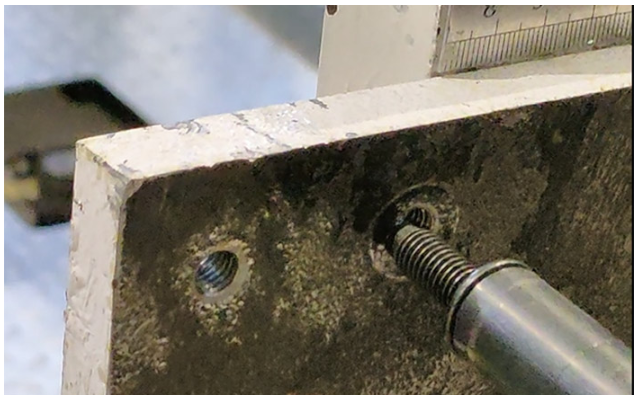
The emergence of Danikor's floating tightening technology has successfully solved this problem. This technology uses the socket floating function of the external hex blow-feed plus vacuum suction or pick-and-place tightening module. Through special structural design, the socket has a certain degree of floating range. When the product's threaded hole positioning is inaccurate, the socket's floating allows for adaptive adjustment, thereby still enabling bolts to be tightened into the threaded holes of the car body.
The Technology Has the Following Advantages:
Improving Tightening Success Rate
The socket floating distance can vary according to the change in avoidance length, with an allowable deviation range typically between 0.5-2.5mm. This significantly enhances the bolt's hole-seeking ability, greatly improving the bolt's insertion success rate. It can also overcome abnormal friction during the tightening process caused by the overlap between friction work in the threaded pair and the rapid screwing-in phase, thereby improving tightening success rates.
Higher Takt Time, Lower Cost
Compared to traditional camera positioning solutions, floating tightening technology not only demonstrates superior performance but also has obvious advantages in takt time. Because it does not rely on high-precision vision systems, floating tightening technology can achieve higher production efficiency. Furthermore, due to reduced requirements for precision equipment, overall costs are effectively controlled, saving enterprises significant production expenses and achieving cost reduction and efficiency improvement.
In body-in-white assembly, precise tightening processes are crucial, while traditional methods often struggle to cope with challenges brought by dimensional fluctuations and positioning errors. Danikor's floating tightening technology, through clever socket design, improves assembly speed while ensuring precision and effectively reduces production costs. The promotion and application of this technology undoubtedly provides a more reliable and efficient solution for automated assembly in the automotive manufacturing industry.