In automated production lines for 3C electronics, automotive components, and medical devices, springs serve as core elastic elements. The efficiency and precision of their assembly and inspection processes directly determine the yield and capacity of the entire production line. However, due to their helical structure, complex end bends, and tendency to tangle and deform, springs have become a "chronic headache" for automated feeding. Traditional rigid vibratory bowls often cause spring entanglement and jamming, as well as bending deformation. Additionally, the minimal feature differences between left-hand and right-hand springs and their front/back sides make accurate distinction difficult for traditional vision systems, leading to frequent mixing and false detection issues.
I. Core Pain Points of Traditional Spring Feeding
Traditional spring feeding mostly employs spiral vibratory bowls, relying on rigid tracks and forced sorting logic. When handling irregular and fragile components like springs, four critical flaws are exposed:
Frequent Tangling and Jamming: The helical structure of springs makes them prone to mutual entanglement. After stacking, they form "material clumps." Rigid vibration not only fails to effectively disperse them but also exacerbates tangling, causing jamming and downtime. Feeding success rates are only 80%-85%.
Bending and Deformation Damage: Collisions and friction between springs and the rigid bowl and tracks easily cause slender springs and micro-springs (wire diameter <1mm) to bend, twist, and deform, with scrap rates exceeding 5%.
Unstable Visual Recognition: The complex shapes of spring end bends and the minimal feature differences between left-hand/right-hand springs and their front/back sides make traditional vision systems, which rely on manually set feature points, achieve recognition accuracy of less than 95%. This results in front/back mixing and missed inspections.
Extremely Low Changeover Efficiency: Springs with different wire diameters, coil counts, and winding directions require customized dedicated tracks. Changeover takes 2-4 hours, making it unable to adapt to multi-variety, small-batch flexible production needs.
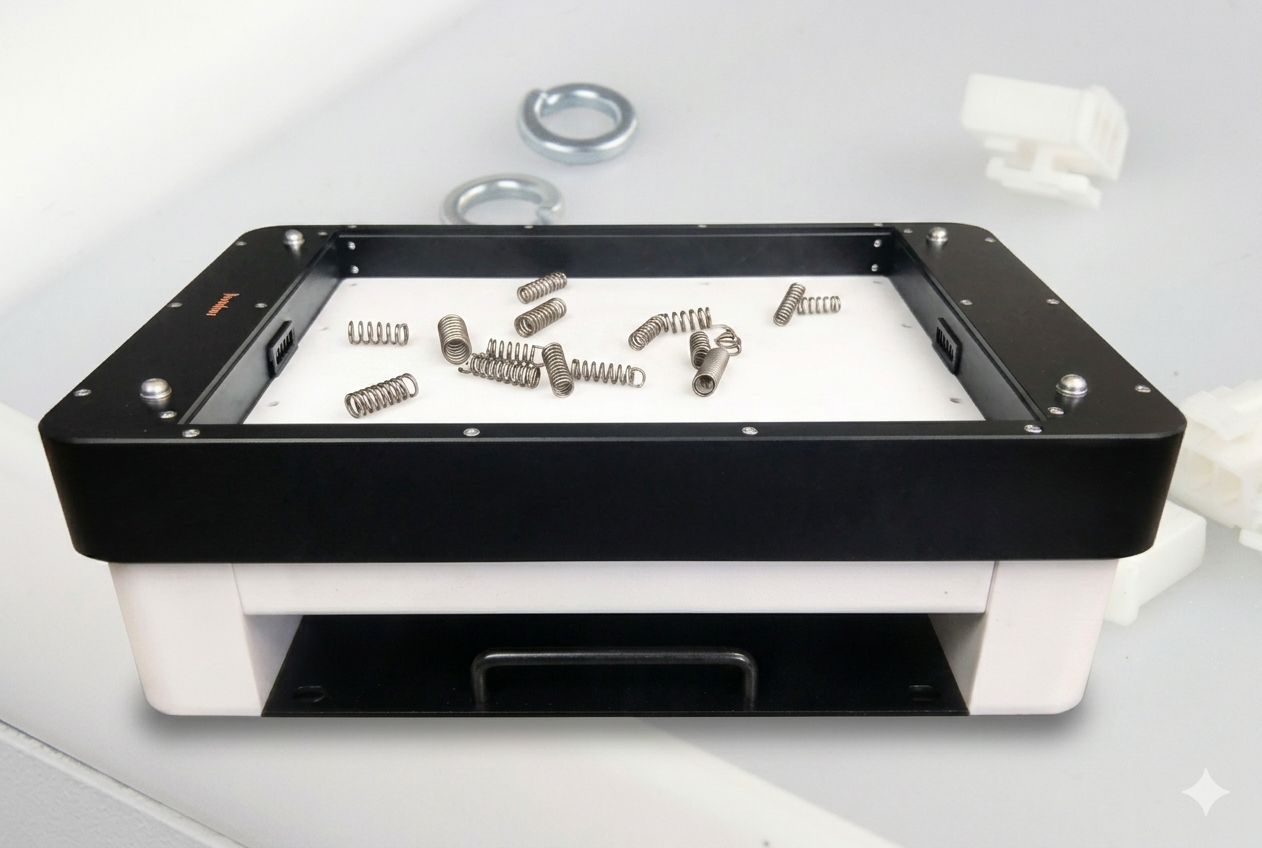
II. Core Solution for Spring Flexible Feeding
Danikor's spring flexible feeding system adopts "flexible dispersion + vision AI + precision picking" as its core logic. Through the coordination of customized hardware and software algorithms, it achieves damage-free, efficient, and precise spring feeding.
Flexible Vibration: Unlike traditional vibratory bowls that rely on electromagnetic drive to achieve single-track vibration and struggle to accommodate the conveying needs of tiny, irregular, and fragile materials, flexible feeding uses four high-performance voice coil motors controlled by phase difference to achieve dispersion and flipping effects within the bowl. Even entangled springs can be easily separated. The anti-roll surface allows springs to quickly settle and maintain their posture, facilitating vision recognition and precise positioning for picking.
AI Vision Intelligent Algorithm: Precisely distinguishing front/back and overcoming left-hand/right-hand recognition challenges. Springs (especially left-hand and right-hand springs) have minimal feature differences between their front/back sides and winding directions, making stable recognition difficult for traditional vision systems. AI vision self-learning algorithms become the key breakthrough:
Multi-angle Feature Self-learning: The system automatically collects sample images of spring front sides, back sides, and different winding directions for modeling. Through deep learning algorithms, it automatically extracts subtle differences in spiral patterns, bend contours, and end face features to establish high-precision recognition models.
Flying Capture Technology Enhancement: After springs are picked from the vibratory bowl, their position in the gripper often has slight deviations. Therefore, a bottom-view flying capture camera is added between the vibratory bowl and the placement point. When the robot passes through the center of the camera's field of view with the part, it triggers a millisecond-level snapshot. The system then calculates the deviation of the part relative to the gripper center in real-time and automatically corrects it before moving to the placement point. This improves placement accuracy while maintaining cycle time.
Summary
Flexible feeding technology, through flexible vibration to prevent tangling, slotted and perforated material bowls to prevent deformation, AI vision to precisely distinguish front/back, and flying capture technology for high-speed defect detection, constitutes a complete automated feeding solution for precision springs that thoroughly resolves the core pain points of traditional feeding.
In the current era of intelligent and flexible manufacturing transformation, this solution has been widely applied in automotive seat springs, medical micro-springs, electronic precision springs, and other fields, becoming core technology for improving the efficiency, yield, and competitiveness of spring assembly production lines. When selecting equipment, enterprises need to customize matching material bowls and vision algorithms based on spring wire diameter, size, winding direction, and surface requirements to achieve optimal feeding performance.