How Dynamic Axial Force Control Helps Prevent Screw Float and Thread Stripping
In automated assembly, screw float (a screw sitting above the intended seating surface) and thread stripping are often treated as torque-control problems. Adjusting the tightening torque may change the result, but it does not always address the true cause. In many applications, poorly controlled axial force and Z-axis motion are the more important factors.
A screw needs different levels of axial force as it approaches the hole, engages the first thread, runs down and reaches final tightening. Conventional spring-loaded or pneumatic mechanisms cannot always vary this force at the right moment. A servo screwdriving module can coordinate axial force, feed speed, spindle speed, torque and position throughout the fastening cycle, helping manufacturers reduce thread damage, incomplete seating and false OK results.
Quick Answer
Dynamic axial force control helps prevent screw float and thread stripping by applying the appropriate downward force at each stage of screwdriving. Low force and low feed speed protect the first thread during engagement; controlled medium force maintains stable bit contact during rundown; and stable axial force supports effective torque transfer during final tightening. Real-time Z-axis position monitoring also helps verify whether the screw has reached its intended seating depth.
Why Torque Control Alone May Not Solve Screwdriving Defects
Torque describes the rotational input applied to the fastener. It does not, by itself, describe whether the driver bit remains fully engaged, whether the screw entered the hole correctly or whether the screw head reached the required seating position. The fastening process therefore depends on both rotational control and axial motion control.
If axial force is excessive during initial thread engagement, the first threads may be impacted, deformed or cross-threaded. If axial force is insufficient during rundown or final tightening, the bit may lift or slip in the screw recess. Torque may then be lost through poor bit engagement instead of being transferred effectively into the joint. The result can be a high screw, damaged recess, stalled rundown or stripped thread.
How Axial Force Requirements Change During the Tightening Cycle
1 Initial Approach
During the initial approach, the driver advances toward the workpiece while the screw has not yet contacted the threaded hole. There is no thread engagement resistance at this point. The main requirement is to maintain screw alignment and bit stability.
Because no thread contact has occurred, the axis can move quickly through this non-working distance. Minimizing this idle travel time improves cycle efficiency without placing the threads at risk.
2 Hole Entry and First Thread Contact
When the screw tip reaches the hole entrance, the first thread is about to engage. This is one of the most sensitive stages of the process. Excessive feed speed or axial force can drive the screw against the thread start before proper alignment is established.
A controlled transition to low feed speed and light axial force helps the screw enter smoothly. This reduces impact loading on the first thread and lowers the risk of cross-threading, plastic deformation and later rundown resistance.
3 Thread Rundown
Once the mating threads are correctly aligned and engaged, the screw enters continuous rundown. Moderate axial force is normally needed to keep the driver bit seated securely in the screw recess while the screw advances.
Stable bit engagement improves torque transfer and reduces axial movement or cam-out. At this stage, the system can increase rotational and feed speed within the limits of the application to support a shorter cycle time.
4 Final Tightening and Seating
Final tightening begins when the underside of the screw head contacts the workpiece and the joint starts to build clamp load. The process now changes from free rundown to load-bearing fastening.
If axial force is too low, the bit can slip or partially disengage as tightening torque rises. The commanded torque may not be transferred efficiently to the joint, and the screw may stop before reaching the required seating depth. Maintaining suitable axial force, together with a controlled low-speed final tightening strategy, helps the tool keep stable contact and complete the fastening cycle consistently.
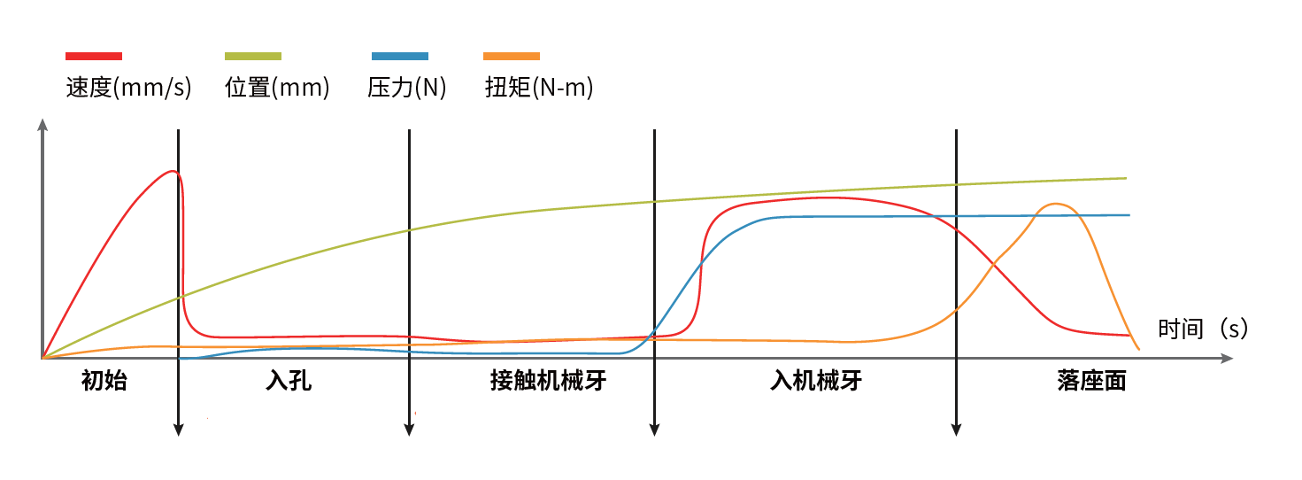
Why Springs and Pneumatic Cylinders Have Control Limitations
Traditional automatic screwdriving units commonly use a spring or pneumatic cylinder to generate downward force. These mechanisms are practical for many simple processes, but their force behavior is difficult to adapt dynamically across all four stages.
Spring-loaded mechanisms generate force according to compression. The applied force changes with travel and cannot be freely programmed for each stage.
Pneumatic cylinders are affected by air-pressure variation and typically provide a set force rather than a precisely programmed force profile.
Neither method readily coordinates force changes with thread contact, rundown and final seating in real time.
A fixed or mechanically determined force can therefore be too high during thread entry and too low when higher torque must be transferred. This mismatch can contribute to both thread damage and incomplete seating.
How a Servo Screwdriving Module Controls Axial Force Dynamically
Danikor's servo screwdriving module uses servo-driven Z-axis control to coordinate movement and axial force during the tightening sequence. Process parameters can be assigned by stage so that the module responds to the changing mechanical conditions rather than applying the same downward force throughout the cycle.
Stage | Axial force | Motion strategy | Purpose |
Initial approach | No process force required | Fast Z-axis advance | Reduce non-working travel time |
Hole entry | Light, controlled force | Low feed speed | Protect the thread start and support alignment |
Rundown | Moderate force | Faster controlled rotation and feed | Maintain bit engagement while improving cycle time |
Final tightening | Stable moderate force | Low-speed final tightening with higher torque | Support torque transfer and complete seating |
Z Axis Position Monitoring for Screw Seating Verification
Force control addresses how the screw is driven, while position monitoring helps verify where the screw finishes. The servo system's position feedback can monitor the actual Z-axis depth throughout the cycle and compare the final position with the defined process window.
If the screw does not reach the expected seating depth, the system can identify a potential high-screw condition for further process logic or OK/NG verification. Because position feedback is provided by the servo axis, the application may not require a separate displacement sensor. The exact detection logic and acceptance limits should be configured for the fastener, joint stack-up and production tolerances.
Full Process Data for Traceability and Automation Integration
A controlled screwdriving process produces more than a final torque value. The Danikor servo screwdriving module can monitor process variables including speed, Z-axis position, torque, axial force and time. These data help engineers analyze the complete fastening sequence and distinguish between a torque-related issue, a thread-entry problem and an incomplete seating condition.
The module also supports information exchange and control logic with the customer's control system or PLC. Available interfaces and integration details should be confirmed for the selected configuration. When connected to the production data architecture, the process records can support fastening data traceability, quality review and Industry 4.0 manufacturing workflows.
Engineering Benefits for Integrators and Manufacturers
Lower risk of thread damage during hole entry and first-thread engagement
More stable bit-to-screw contact during rundown and final tightening
Better detection of incomplete seating through Z-axis position monitoring
Programmable stage-based motion and force profiles for different products
Process data that supports troubleshooting, quality control and traceability
Potential reduction in external displacement-sensor hardware, depending on the application
What Information Is Needed to Configure the Process
A reliable force and motion profile should be developed around the actual joint. When evaluating a servo screwdriving module, provide the following information:
Screw type, size, length, head style and drive recess
Workpiece and threaded-hole materials
Target torque and any torque-angle acceptance requirements
Required seating depth and allowable position tolerance
Cycle-time target and available installation space
Automation layout, PLC communication and data-traceability needs
Conclusion
Screw float and thread stripping are not always solved by changing the torque setting. Because the screw experiences different mechanical conditions during approach, thread entry, rundown and final tightening, each stage requires an appropriate combination of axial force, feed speed, rotational speed, torque and position control.
A servo screwdriving module with dynamic axial force control and real-time Z-axis position monitoring gives integrators and manufacturers a more complete way to manage these variables. By protecting initial thread engagement, maintaining stable bit contact and checking final seating position, the system helps reduce fastening defects while improving process visibility and traceability.
To evaluate a Danikor servo screwdriving solution for your assembly line, share your fastener specifications, joint materials, torque requirements, seating-depth tolerance, cycle-time target and PLC integration needs with our engineering team.
Frequently Asked Questions
What is screw float in automatic screwdriving?
Screw float is a condition in which the screw head remains above the intended seating surface after the fastening cycle. It may result from poor thread engagement, insufficient axial force, bit slippage, joint interference or an unsuitable tightening strategy.
Can increasing torque fix a high screw?
Not always. If the driver bit is not fully engaged or the screw is misaligned, increasing torque can worsen recess or thread damage. Axial force, feed motion, seating depth and joint conditions should be checked before changing the torque target.
Why is low axial force useful at the start of thread engagement?
Light axial force reduces impact on the first thread and gives the screw a better opportunity to align with the threaded hole. This helps lower the risk of cross-threading and thread-start deformation.
Why is more axial force needed during final tightening?
As tightening torque rises, adequate axial force helps keep the driver bit seated in the screw recess so torque can be transferred into the joint instead of being lost through slip or cam-out.
How does a servo screwdriving module detect an improperly seated screw?
The servo axis monitors actual Z-axis position during the cycle. The final position can be compared with a configured seating-depth window to identify a possible high or incompletely seated screw.
Does servo position monitoring eliminate the need for a displacement sensor?
It may remove the need for a separate sensor in suitable applications because the servo system already provides position feedback. The decision depends on the required accuracy, mechanical layout and validation requirements.
What data can be monitored during servo screwdriving?
Depending on the selected configuration, process monitoring can include speed, position, torque, axial force and time. These records support troubleshooting, OK/NG verification and fastening data traceability.